Key findings
01 — The BifurcationWhy is automotive both cutting jobs and hiring at once?
Automotive's 2026 labor market is really two markets moving in opposite directions — shrinking legacy, scarce software.
Detroit's "Big Three" automakers have collectively cut more than 20,000 U.S. salaried positions — 19% of their combined white-collar workforce — since peak employment earlier this decade, even as they simultaneously post over 2,000 open roles, nearly 400 of them AI-specific.1 GM is executing a direct "skills swap," laying off 500–600 IT workers while hiring AI-native engineers, data engineers, and prompt specialists — and reports that nearly 90% of the code in its autonomous-driving software is now AI-written, up from near zero two years ago.2
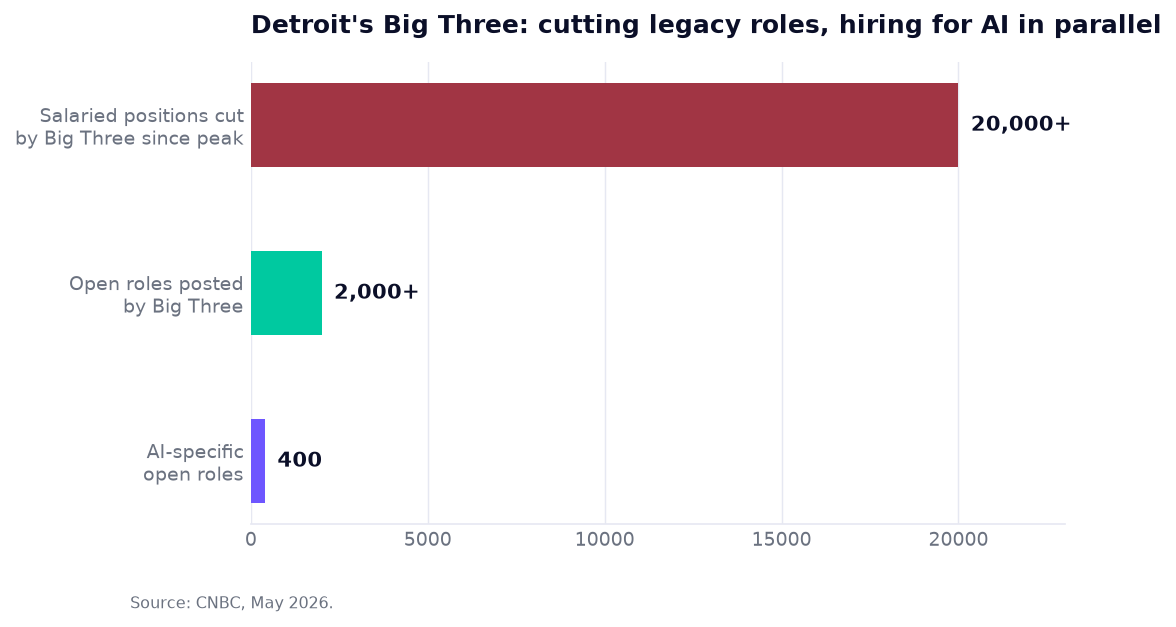
In the U.S., the same bifurcation shows up inside individual companies — a skills swap, not a simple cost-cutting headcount reduction, reflecting a broader pivot toward software-defined vehicles.2
02 — The ClockHow long does it really take to fill automotive roles?
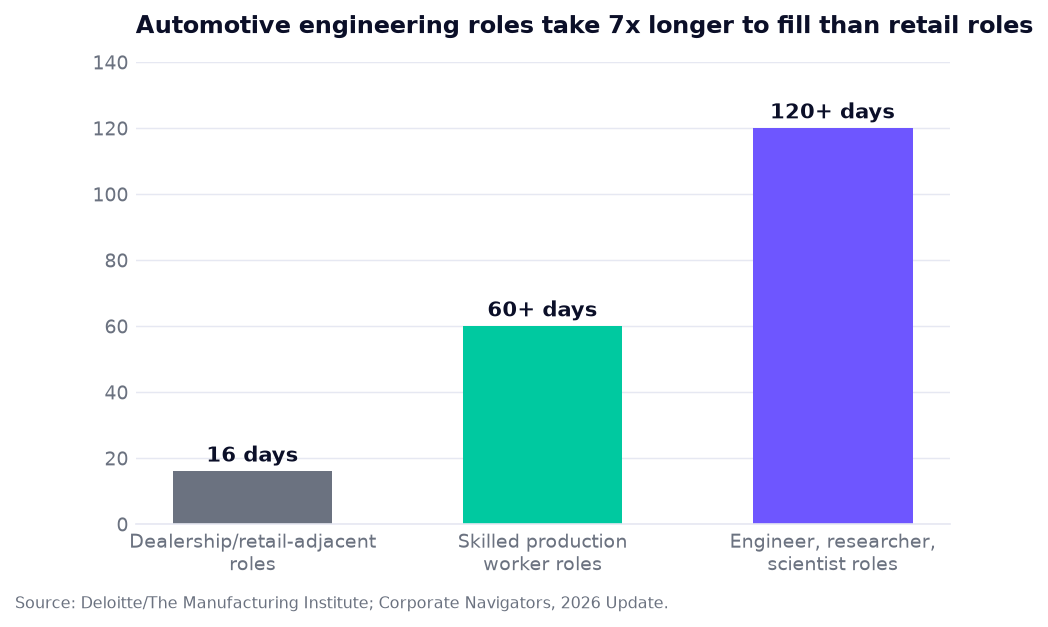
Engineering and research roles take 4x longer than skilled production roles, and 7x longer than retail-adjacent roles.
Skilled trades and engineering hiring in automotive already runs far longer than typical white-collar benchmarks. Deloitte/Manufacturing Institute data show it takes more than 2 months (60+ days) to fill skilled production worker roles, and more than 4 months (120+ days) to fill engineer, researcher, and scientist roles — among the longest cycle times of any occupational category tracked.5 This contrasts sharply with the broader "Automotive" category in general recruiting benchmarks, which some staffing firms peg as low as 16 days for typical dealership/retail-adjacent roles.13
Deloitte and The Manufacturing Institute project the U.S. manufacturing skills gap could leave an estimated 2.4 million positions unfilled and put $2.5 trillion in manufacturing GDP at risk over the coming decade.5
03 — The Global ScrambleWhy is software-defined-vehicle talent so hard to find?
Automakers are structurally disadvantaged against tech and EV-native rivals for the software engineers their strategy depends on.
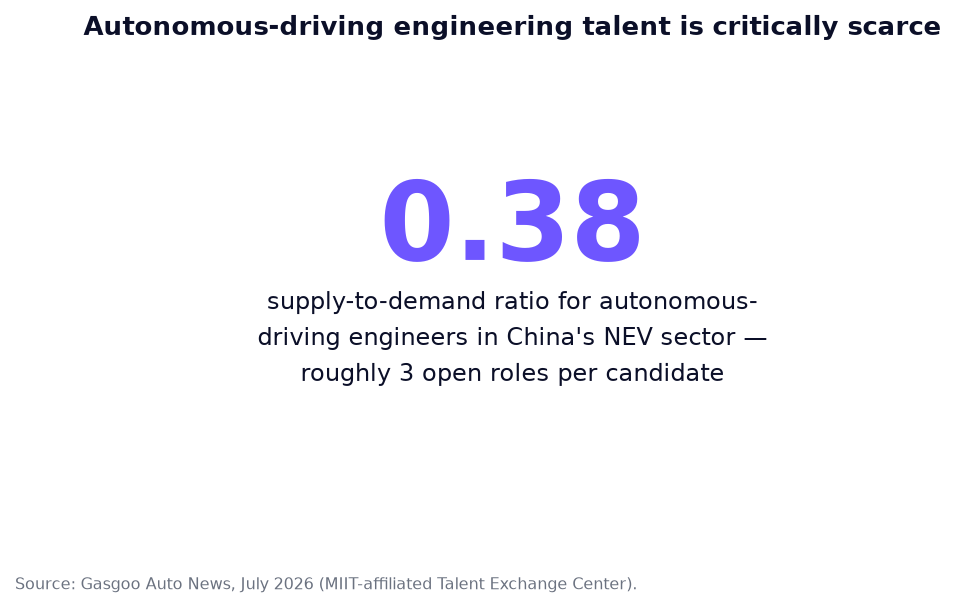
China's new-energy vehicle (NEV) sector faces a projected talent shortfall of 1.03 million workers, with the supply-demand ratio for autonomous-driving engineers at just 0.38 — meaning roughly three open roles compete for every one qualified candidate — prompting automakers to open R&D centers in the U.S., Europe, and Japan purely to hunt for scarce global talent.3
Compensation gaps versus tech and EV-native rivals persist: historical comparative data show traditional automaker software engineers earning meaningfully less than counterparts at Tesla, Rivian, Cruise, and Big Tech for comparable roles — even accounting for regional cost-of-living differences. Current U.S. market data put automotive software engineer total pay in the $100K–$158K range with a median near $125K.
"Automakers are turning to more dynamic, always-on sourcing rather than static annual hiring plans — treating talent with the same forecasting rigor applied to parts and materials."
04 — The VolatilityWhy does automotive hiring whiplash so hard?
EV retrenchment is producing large, repeated layoff waves — making static annual hiring plans obsolete.
U.S. motor vehicles and parts manufacturing employment fell 16,200 jobs year-over-year through May 2026, continuing a multi-year contraction even as EV and software roles remain understaffed.4 GM idled Factory Zero to a single shift in January 2026 (cutting ~1,200 jobs), temporarily laid off 1,300 workers in a subsequent 30-day production adjustment, and paused battery-cell production at its Ultium plants in Ohio and Tennessee, affecting 2,100 more workers.67 Ford and Stellantis show the same pattern of volatility across their EV programs.89
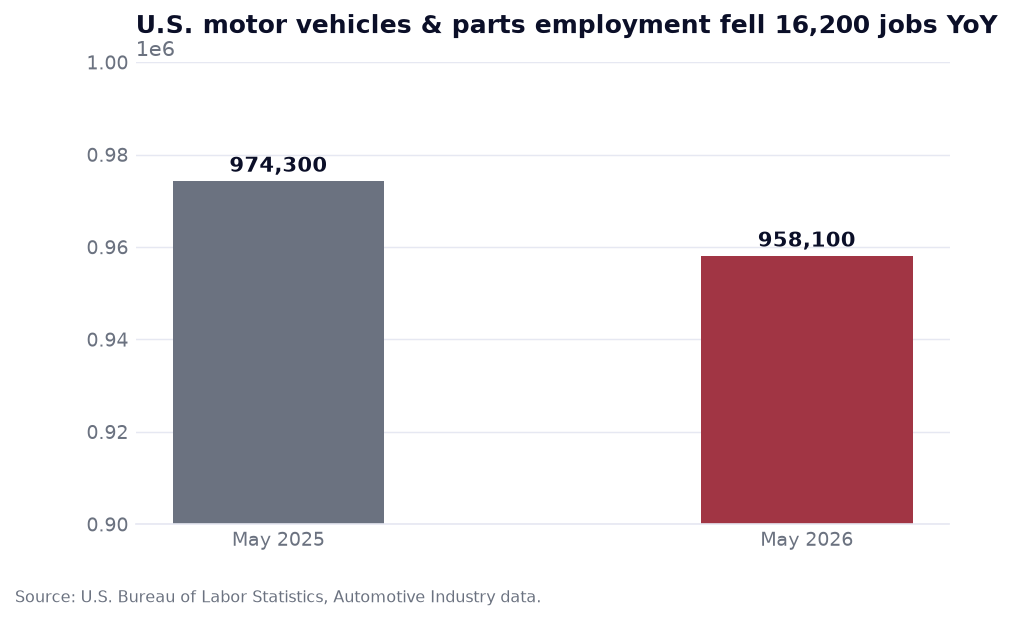
This volatility is precisely why automakers are turning to more dynamic, always-on sourcing rather than static annual hiring plans — industry white papers explicitly call for automakers to apply "predictive hiring, workforce modeling, and talent logistics" with the same rigor as supply-chain planning.11
05 — The Reskilling WaveWhat happens to workers displaced by the ICE-to-EV shift?
The legacy-to-EV workforce transition is a global undertaking, and reskilling ICE-trained talent is now a strategic sourcing category.
Tata Motors has committed to reskilling more than 50% of its workforce (with over 57,000 employees at various stages of training) to move mechanical engineers who worked on internal combustion engines into electronics and software disciplines.12 In the U.S. supply base, the disruption has been severe enough to trigger major supplier restructuring: Bosch announced plans to cut 13,000 jobs (10% of its German workforce), and ZF Group announced it would lay off 7,600 employees in its electrified powertrain unit by 2030.10
Manufacturers cite shifting skillsets from new technology/automation and the retirement of baby boomers as the two leading structural drivers of the skills gap, with 50% of manufacturers already having adopted automation and citing critical thinking, programming, and digital skills as the top capabilities needed going forward.5
06 — The PlaybookWhat should an automotive talent team do about it?
Five moves separate the manufacturers and suppliers that will win the next 24 months of automotive hiring:
1. Source simultaneously across two very different talent markets. Build parallel, purpose-built pipelines for software/AI engineering talent (competing directly with Big Tech compensation and speed norms) and skilled-trades/manufacturing talent.
2. Move faster than the 4-month engineer/scientist hiring cycle. Automated sourcing that pre-qualifies SDV, battery, and autonomous-driving engineering candidates can compress the 120+ day traditional cycle materially.
3. Track and target the scarce autonomous-driving/software talent pool globally. With a supply-demand ratio as thin as 0.38 candidates per role, this requires continuous, cross-border sourcing rather than reactive regional postings.
4. Support reskilling-to-hiring pipelines for the ICE-to-EV transition. Identify internal or externally displaced ICE-trained engineers and technicians who are strong reskilling candidates for EV/battery/software roles.
5. Apply predictive, supply-chain-style workforce planning to hiring. Run talent acquisition with the same forecasting discipline used for parts and materials.
This is precisely the model UPPER was built to run: autonomous sourcing that runs two parallel pipelines at once — scarce SDV/battery engineering and skilled-trades roles — so automotive talent teams stop losing the talent war on either front.
Get the designed PDF edition
The full report, formatted as a shareable PDF for your team and clients. Enter your work email and we'll unlock the download.
★ Download the PDFSources
- CNBC — "Detroit automakers have cut over 20,000 U.S. salaried jobs..." (May 2026)
- The Next Web — "GM lays off 600 IT workers in AI skills swap" (May 2026)
- Gasgoo Auto News — "MIIT Talent Exchange Center: Key NEV Tech Talent in Short Supply" (July 2026)
- Bureau of Labor Statistics — Automotive Industry: Employment, Earnings, and Hours
- Deloitte / The Manufacturing Institute — "The jobs are here, but where are the people?" skills gap infographic
- WardsAuto — "GM temporarily lays off 1,300 workers at Factory Zero EV plant" (March 2026)
- World Socialist Web Site — "GM layoffs escalate auto industry's global job-cutting campaign" (Oct 2025)
- USA Today — "Ford slashes 350 vehicle software jobs to boost efficiency" (May 2025)
- Yahoo Finance/AP — "The full list of automakers cutting jobs" (March 2025)
- MotorBiscuit — "One Auto Company is Laying Off 13,000 Workers" (Feb 2026)
- SAE Detroit Section — 2025 Global Leadership Conference White Paper
- The Hindu — "Tata Motors to reskill 50% staff to transition to EV manufacturing by 2027"
- Corporate Navigators — "Average Time To Fill (2026 Update)"
This report synthesizes third-party research current as of July 2026; figures are attributed to their original sources above. Automotive software engineer salary figures are crowdsourced/aggregator compensation data rather than government statistics and should be read as directional market benchmarks; China NEV talent-shortfall figures are drawn from a single named industry source and should be treated as an industry estimate. UPPER edition H2 2026 — refreshed semiannually.