Key findings
01 — The DemandWhy is banking talent so hard to hire in 2026?
Because demand is shifting toward niche, regulated skills — RegTech, AML/KYC, digital — that legacy banking talent pipelines were never built to supply.
Banking's talent problem isn't headline headcount growth — it's an acute mismatch between the skills institutions have and the skills they now need. Financial Activities employment sat at 9,104,000 jobs as of May 2026 after a period of modest growth followed by cooling, and within finance and insurance specifically, total industry job openings measured 243,000 in May 2026 alone, with roughly 127,000 hires and 134,000 separations in the same month — a sign of high churn even in a plateauing headcount environment.67
Layered on top is intensifying demand for regulated skill sets that barely existed a decade ago: RegTech and compliance automation, AML/KYC/sanctions expertise, data analytics, and cybersecurity.4 The AML function is a case study in scarcity — the qualified talent pool is shrinking even as regulatory scrutiny and enforcement risk rise.8
02 — The ClockHow long does it really take to fill a banking role?
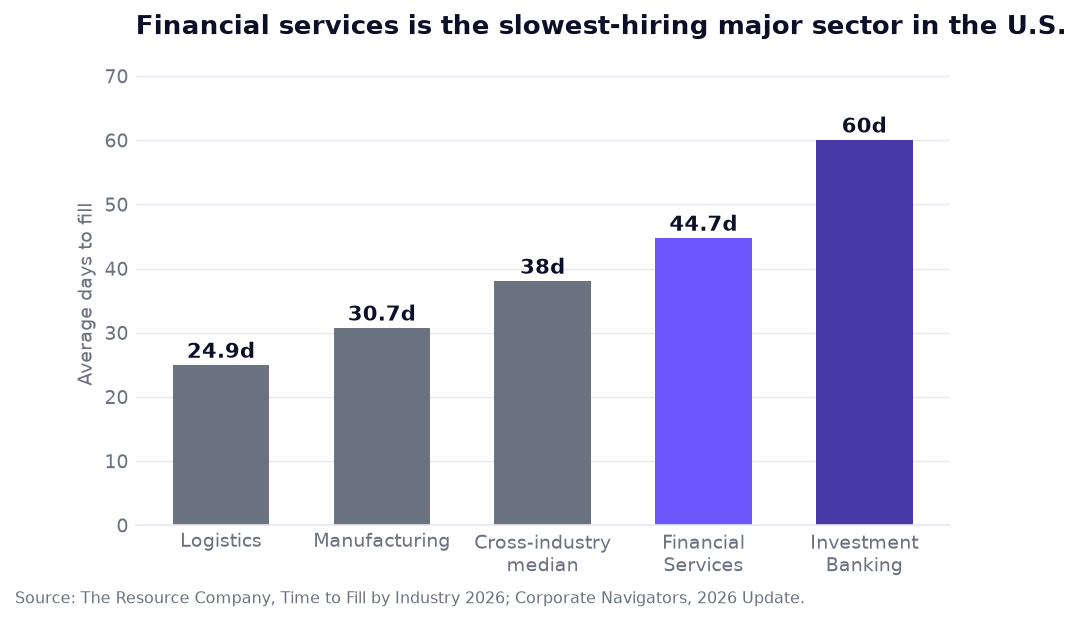
Financial services is the slowest-hiring major sector in the U.S. — and the reasons are structural, not incidental.
Financial services consistently ranks as the slowest-hiring major industry in third-party benchmarking, averaging 44.7 days — compared with 30.7 days for manufacturing and 24.9 days for logistics.5 Investment banking specifically runs even longer, at an estimated 60 days.12 This elongated cycle stems from mandatory background investigations, credential/licensing verification (Series 7/63/65, FINRA registration), and multi-stakeholder compliance sign-off — frictions that don't exist in most other sectors, and that create real competitive exposure when fintech rivals move faster.
The cost of this delay compounds: every extra day a regulated seat sits open is a day of coverage risk on compliance, risk, or client-facing functions that cannot simply go unstaffed.
03 — The SqueezeWhy are banks losing the talent race on two fronts at once?
Banks face regulatory hiring constraints AND fintech competition for the same digital talent — simultaneously.
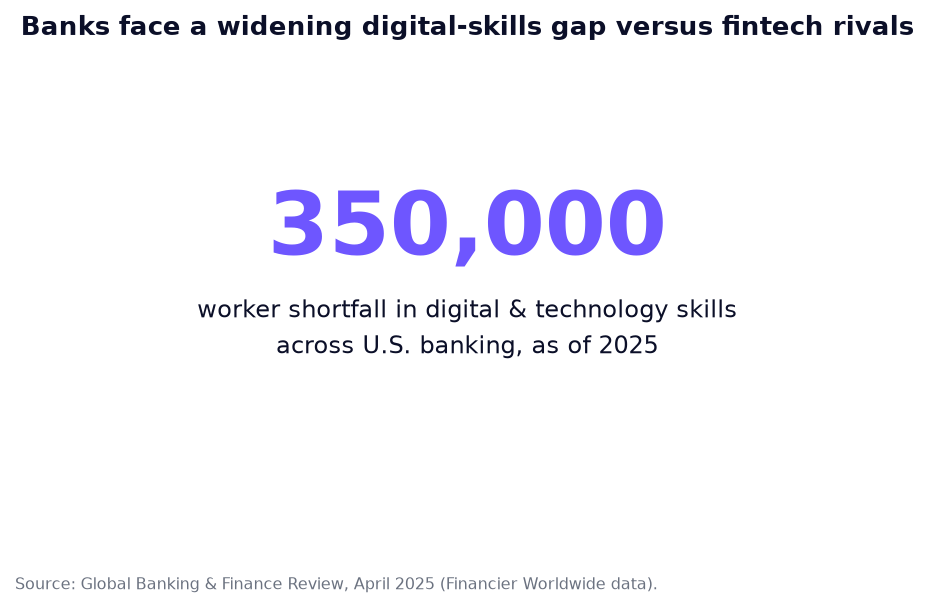
Every hire into a regulated role (trading, compliance, risk, AML, wealth advisory) must clear licensing, background screening, and often regulator-notification requirements — a fixed time cost that fintech challengers hiring for similar analytical skills do not bear to the same degree.5 At the same time, banks are competing against fintechs and Big Tech for data scientists, cybersecurity engineers, and digital product talent — the same 350,000-worker shortfall — often while offering less flexible compensation and slower-moving pipelines than tech-native rivals.4
The pressure shows up unevenly across the industry. Citibank, Wells Fargo, and Bank of New York Mellon alone cut a combined 8,580 jobs between Q2 and Q3 2025, while institutions below the $250 billion asset threshold grew employment 0.2% in the same period — legacy institutions shedding headcount while smaller and newer players keep hiring.3 Full-time employment across 4,432 U.S. commercial and savings banks fell a net 7,460 positions year-over-year in Q3 2025, and banks have shed a cumulative 81,000 jobs since headcount peaked in Q1 2023.3
04 — The Succession CrisisWhy is the advisor shortage getting worse, not better?
More advisors are leaving the profession than entering it — and the ones left are aging out fast.
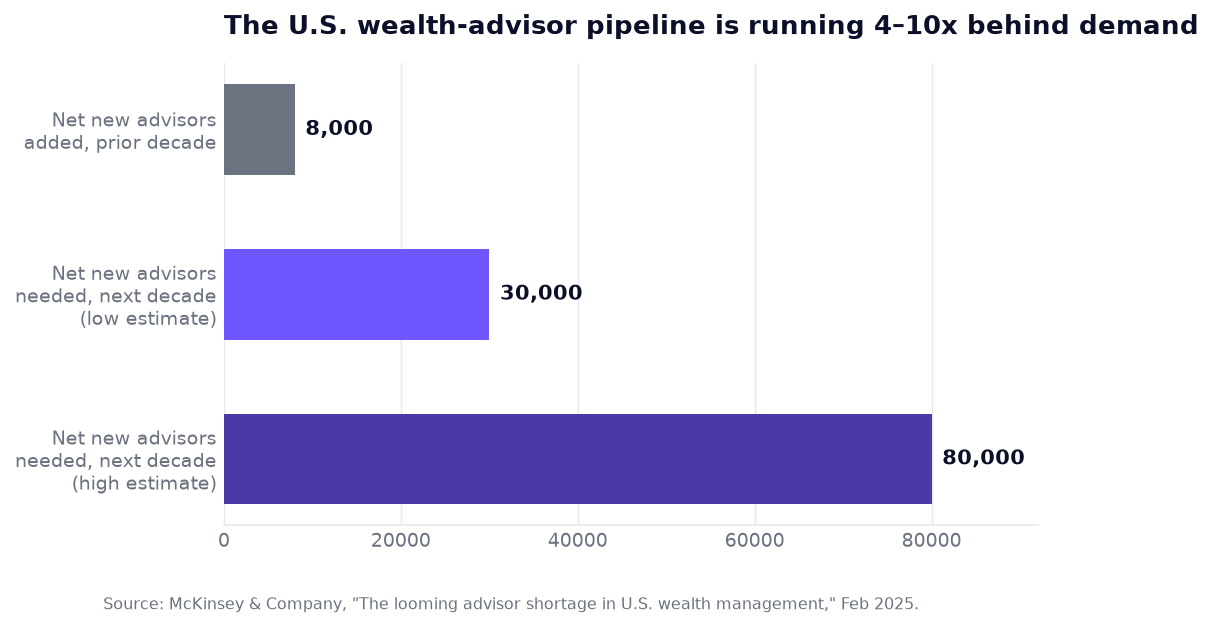
The U.S. wealth management industry faces a projected shortage of roughly 100,000 financial advisors by 2034 — 30–37% of current headcount — even as advised relationships are expected to grow 28–34%.1 The typical financial advisor is 48 years old, and more than 44% are over 50; the industry needs 30,000–80,000 net new advisors over the next decade, compared with just 8,000 net new advisors added in the prior decade.1 Making the pipeline problem worse, 72% of new advisors leave the industry within five years.9
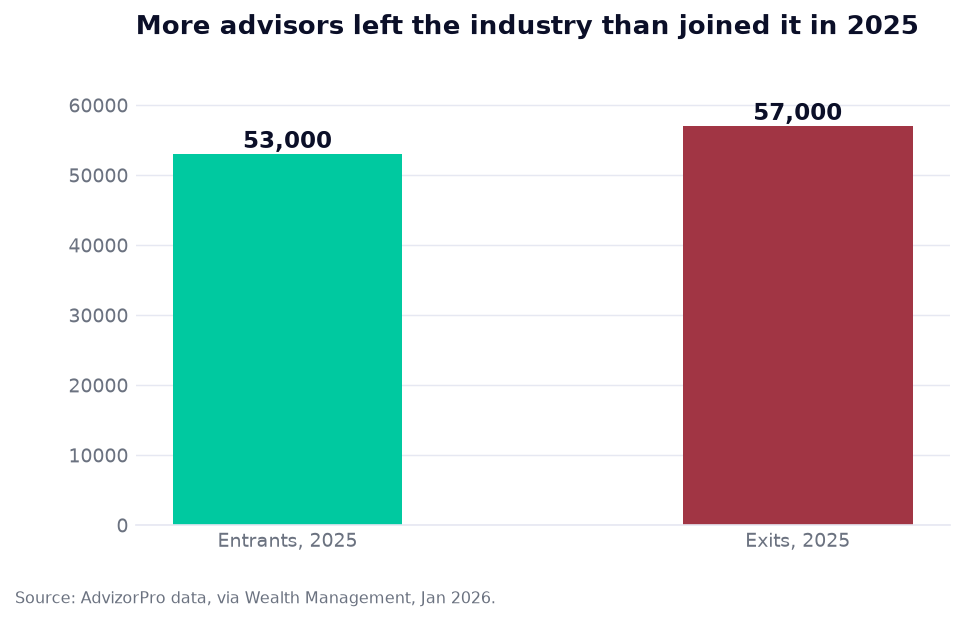
More advisors left the profession than joined it in 2025 — 57,000 exits versus 53,000 entrants — the fourth net-loss year in the last five.2 And the exits already underway aren't quiet retirements: more than 11,172 experienced advisors changed firms in 2025, up 16% from 2024, as RIAs and independent channels pull talent away from traditional wirehouses.11
"46% of wealth advisors are within 10 years of retirement, and 26% are already 65 or older — this isn't a future problem. It's already here."
05 — The Trust LineWhy can't banking hire the way tech companies do?
Banking roles carry fiduciary and systemic-risk stakes — sourcing has to verify credentials and compliance history at scale, without slowing to a crawl.
Unlike most white-collar hiring, banking roles carry fiduciary, regulatory, and systemic-risk stakes: a bad compliance hire can expose an institution to enforcement action; a bad advisor hire can expose retail clients to real financial harm. This is why the industry's hardest-to-fill roles — compliance, risk, AML/KYC, and licensed wealth advisory — require both technical competence and demonstrable integrity and background clearance, not just skills-matching.10 J.D. Power survey data underscore the urgency: 46% of wealth advisors are within 10 years of retirement, and 26% are already 65 or older.10
Any sourcing approach for these roles must verify credentials and compliance history at scale while still moving at competitive speed — the central tension legacy recruiting processes have not solved.
06 — The PlaybookWhat should a banking talent team do about it?
Five moves separate the institutions that will win the next 24 months of banking and financial-services hiring:
1. Pre-verify licensing and regulatory history at the sourcing stage. Build pipelines pre-screened against FINRA/state licensing databases and disclosure history before candidates reach a recruiter, cutting weeks out of the 44.7-day sector average.
2. Run parallel, compliant background workflows instead of sequential ones. Automate credential, sanctions-list, and reference-check steps that currently run serially and drive banking's longest-in-industry time-to-fill.
3. Build always-on specialist pipelines for AML/KYC/risk talent. Given how thin the qualified AML pool has become, continuously-refreshed sourcing is required to compete for scarce compliance professionals.
4. Target succession-risk roles proactively. With 44% of financial advisors over 50 and a 100,000-advisor shortfall projected by 2034, flag succession-critical books of business and start next-generation pipelines years ahead of retirement waves.
5. Compete on speed and reach against fintech, without compromising compliance. Widen the digital/technical sourcing aperture (data science, cybersecurity, RegTech) to match fintech hiring speed while still clearing every regulatory gate.
This is precisely the model UPPER was built to run: autonomous, compliant, multi-channel sourcing that pre-checks licensing and disclosure history and scores candidates against the requirement — so a lean banking talent team can move at competitive speed without cutting a single compliance corner.
Get the designed PDF edition
The full report, formatted as a shareable PDF for your team and clients. Enter your work email and we'll unlock the download.
★ Download the PDFSources
- McKinsey & Company — "The looming advisor shortage in U.S. wealth management" (Feb 2025)
- Wealth Management — "AdvizorPro: More Advisors Left the Industry Than Joined in 2025" (Jan 2026)
- KBRA — "U.S. Employment Data Reveals Cuts to Banking and Finance Jobs" (May 2026)
- Global Banking & Finance Review — "How Financial Institutions Are Competing for Digital-Native Skills" (April 2025)
- The Resource Company — "Time to Fill by Industry, 2026 Report" (Oct 2025)
- Bureau of Labor Statistics — Financial Activities (NAICS 50)
- Bureau of Labor Statistics — Finance and Insurance (NAICS 52)
- AML Intelligence — "The AML recruitment crunch" (March 2025)
- CUNY Journalism/Wealth Management — "America's wealth is growing. The number of financial advisors is not." (Jan 2026)
- American Bankers Association Banking Journal — "Survey: Wealth management industry facing talent shortage" (July 2025)
- Wealth Management/Diamond Consultants — "Advisor Movement Soared 16% in 2025" (March 2026)
- Corporate Navigators — "Average Time To Fill (2026 Update)"
This report synthesizes third-party research current as of July 2026; figures are attributed to their original sources above. Some forward projections are inherently uncertain. UPPER edition H2 2026 — refreshed semiannually.