Key findings
01 — The ScaleHow big is retail and CPG hiring, really?
Retail is the largest private employer in America — and its labor market moves fast in both directions.
Retail is the single largest private-sector employer in the U.S., directly and indirectly supporting 55 million jobs — about 1 in 4 U.S. jobs — and contributing $5.3 trillion to GDP.6 Retail alone directly employs 32.2 million people, representing 26% of total U.S. employment and $3.0 trillion in labor income.6 CPG, meanwhile, is consolidating fast — 140 M&A deals closed in 2025 worth roughly $152 billion, up 50% in value year over year — each reshuffling talent needs across the newly combined organizations.8
02 — The Turnover CrisisWhy does retail lose so many workers?
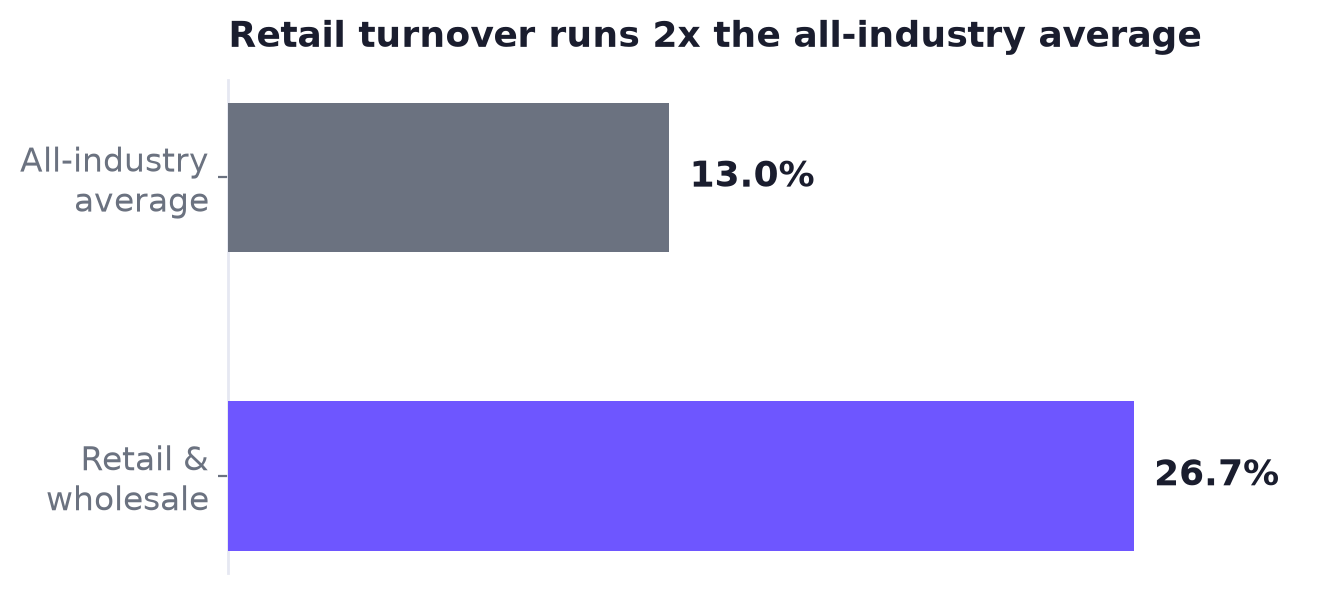
Retail turnover runs roughly 2x the all-industry average — and hourly turnover can top 60%.
Mercer's 2025 U.S. Turnover Survey found voluntary turnover in retail and wholesale at 26.7%, the highest of any sector measured and nearly double the 13.0% all-industry average.1 In-store hourly turnover can run 60% or higher in a given year, and Korn Ferry data shows hourly retail turnover peaked at 75.8% in 2022 before easing to roughly 60–65% by late 2024.914
Much of this is front-loaded: 43% of hourly retail and hospitality staff leave within their first 90 days, and separations run 3.8–4.1% monthly versus a 3.0% all-sector average.1310 The lesson: retail's staffing challenge isn't just filling a role once — it's filling it repeatedly, on a short clock.
03 — The Seasonal ShiftIs seasonal hiring disappearing?
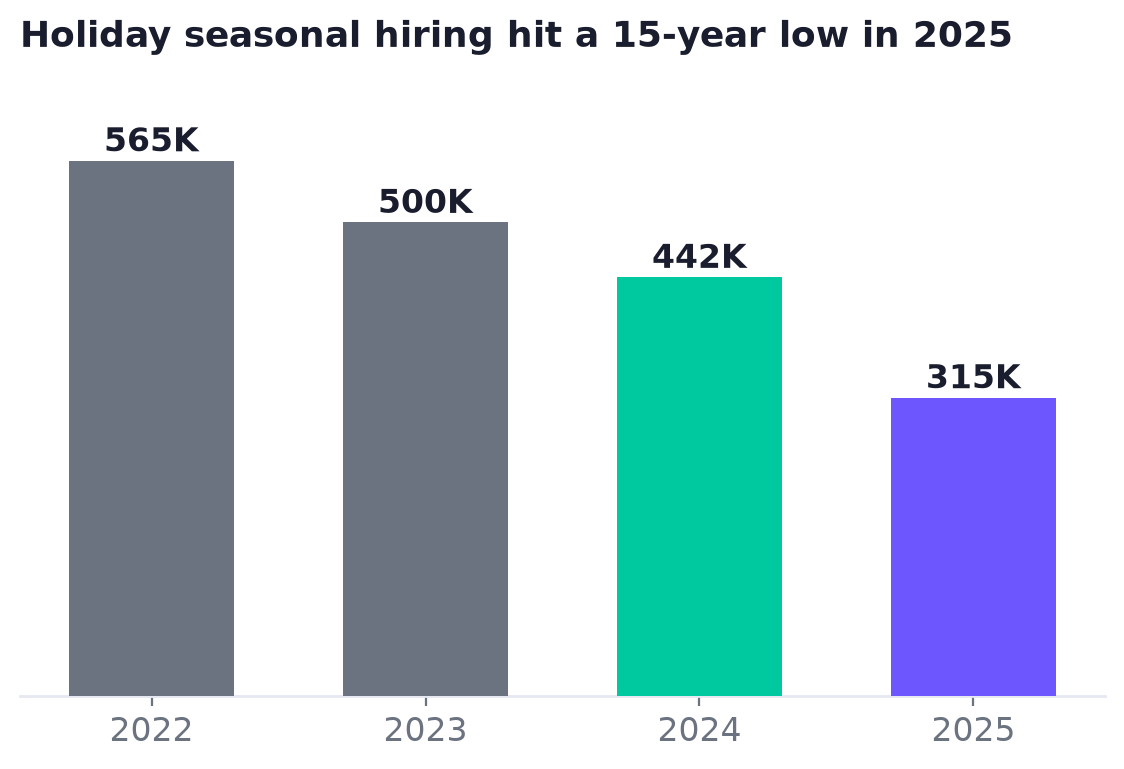
2025 saw the lowest holiday seasonal hiring forecast in 15 years — even as holiday sales hit a record.
NRF forecast just 265,000–365,000 seasonal hires for the 2025 holidays, the lowest level in at least 15 years and down sharply from 442,000 in 2024 — even as holiday sales were projected to surpass $1 trillion for the first time.23 Retailers appear to be leaning more on existing staff hours, automation, and flexible scheduling than on net-new seasonal headcount.
At the same time, overall retail job openings are rising: 737,000 openings in March 2026, up 48% year-over-year, per BLS JOLTS data.7 The mix is shifting — fewer pure seasonal adds, more year-round and specialized roles.
04 — The CPG Skills GapWhat's the hardest talent to find in CPG?
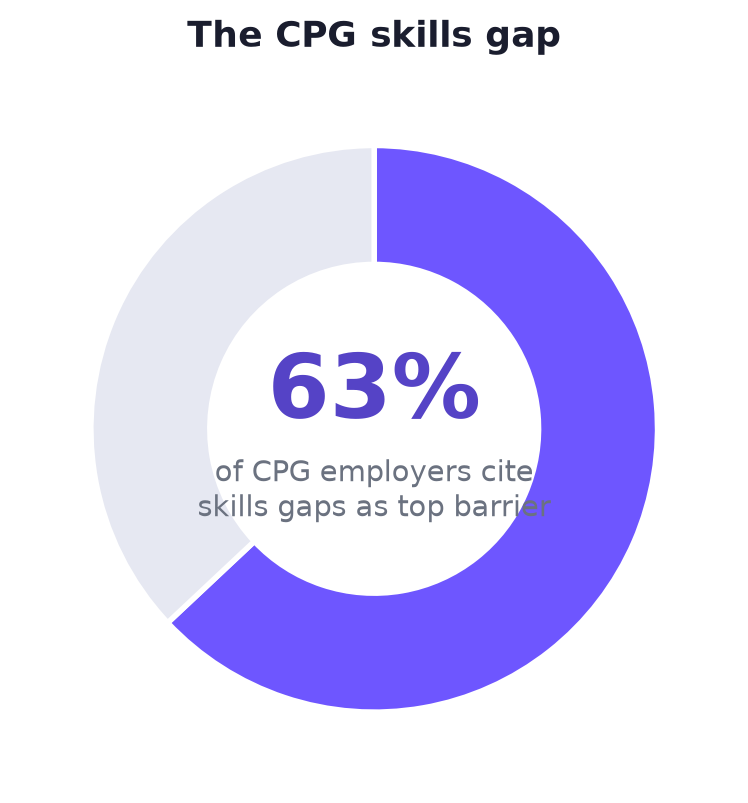
Nearly two-thirds of CPG employers say skills gaps — especially digital and analytics talent — are their biggest growth barrier.
63% of CPG employers cite skills gaps as their primary barrier to growth, and 42% expect talent availability to decline further over the next five years, according to Slayton Search's 2025 CPG talent-war analysis.5 CPG CEO tenure has compressed to just 7.7 years on average, reflecting how much pressure boards are putting on leadership to modernize commercial and digital capability fast.5
"Retail's problem is volume and churn. CPG's problem is scarcity and specialization. Most hiring tools are built for only one of those — not both."
05 — The Application ParadoxIf applicant volume is up, why is hiring still slow?
Retailers now get more applicants per opening than ever — the bottleneck has moved to screening, not sourcing.
Retail openings now draw roughly 43 applicants per role on average, up from 35 — evidence that volume isn't the constraint anymore.7 Yet time-to-fill for retail overall still runs 40–42 days, with corporate and management roles running 45–90+ days and senior roles 90–120+ days.1112 One 2025 analysis found hourly retail time-to-fill improved from 95 to 67 days after retailers automated the top of the hiring funnel — evidence that fixing screening friction, not adding more applicants, is what moves the needle.15
06 — The PlaybookWhat should a retail or CPG talent team do about it?
Five moves separate the retail and CPG organizations that will win the next 24 months of hiring:
1. Automate the top of the hourly funnel. With 43 applicants per opening, instant screening and self-service scheduling — not more sourcing — is where speed comes from.
2. Screen for fit before day one. Since 43% of hourly hires leave within 90 days, matching on genuine fit signals up front reduces the churn that keeps recruiters refilling the same seats.
3. Re-engage your existing pool first. Mine ATS history for previously screened seasonal and hourly candidates before sourcing net-new for repeat roles.
4. Widen the aperture for scarce CPG roles. Skill-graph matching surfaces adjacent-industry digital and analytics talent that keyword search misses.
5. Plan for churn, not just one-time hiring. Build always-on sourcing pipelines for chronically high-turnover roles instead of treating each vacancy as a one-off search.
This is precisely the model UPPER was built to run: autonomous, compliant sourcing and screening that scales for hourly volume and narrows for corporate scarcity — all in one platform, so lean retail and CPG talent teams can staff both ends of the spectrum without two separate toolchains.
The Walmart AI-hiring reference (Section on time-to-fill improvement) is drawn from third-party reporting on a vendor case study, not an independently audited outcome, and is presented here as illustrative context.
Get the designed PDF edition
The full report, formatted as a shareable PDF for your team and clients. Enter your work email and we'll unlock the download.
★ Download the PDFSources
- Mercer — 2025 US Turnover Survey
- CNBC — Retail Holiday Hiring Lowest in 15 Years
- National Retail Federation — 2025 Holiday Sales Forecast
- National Retail Federation — Retail's Impact
- Slayton Search — Securing Executive Leaders in the CPG Talent War
- NRF / PwC — Retail's Impact Report, March 2024
- iCIMS via SDC Executive — Retail and Transportation Job Openings Study
- McKinsey — CPG Reigniting Growth via Portfolio Realignment, Feb 2026
- Actify (citing McKinsey) — Why Retention Matters in Retail
- U.S. Bureau of Labor Statistics — JOLTS Table 4
- Humanly — Time to Hire Benchmarks by Industry
- Tyges (citing SHRM) — The Hidden Toll of an Empty Chair
- Pin AI (citing Fountain) — Retail & Hospitality Hiring Data
- Analysis Atlas — Frontline Workforce Turnover Analysis (Korn Ferry data)
- JobTarget — Q3 2025 Retail Recruitment Report
- McKinsey — AI and Automation in the Consumer Enterprise, June 2025
This report synthesizes third-party research current as of July 2026; figures are attributed to their original sources above. Some forward projections are inherently uncertain. UPPER edition H2 2026 — refreshed semiannually.