Key findings
01 — The ClockHow long does a retained search really take?
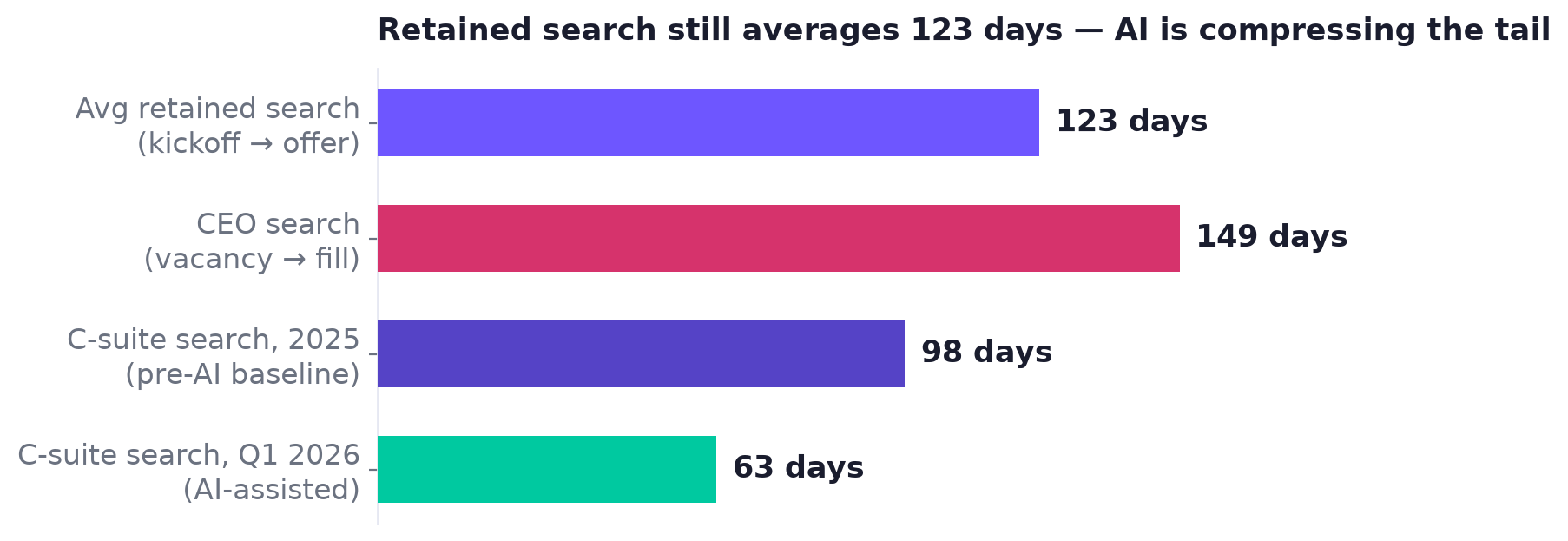
123 days on average — and the tail is getting shorter where firms adopt AI-assisted research.
Clockwork Recruiting's Executive Search Performance Benchmark Report puts the industry average at 123 days from search kickoff to a signed offer, with a 71% overall placement rate across tracked searches.1 CEO searches run even longer: M&A Executive Search's 2025 benchmarking found an average 149-day vacancy-to-fill window for chief executive roles, and 62% of candidates lose interest within two weeks if the process stalls.4
The trend line is moving, though. Data cited by Pin from CJPI shows average C-suite search timelines compressing from roughly 14 weeks in 2025 to 9 weeks by Q1 2026 among firms adopting AI-assisted research and outreach — nearly a 35% reduction in cycle time.5
02 — The Hidden MarketWhy is most executive talent invisible to job postings?
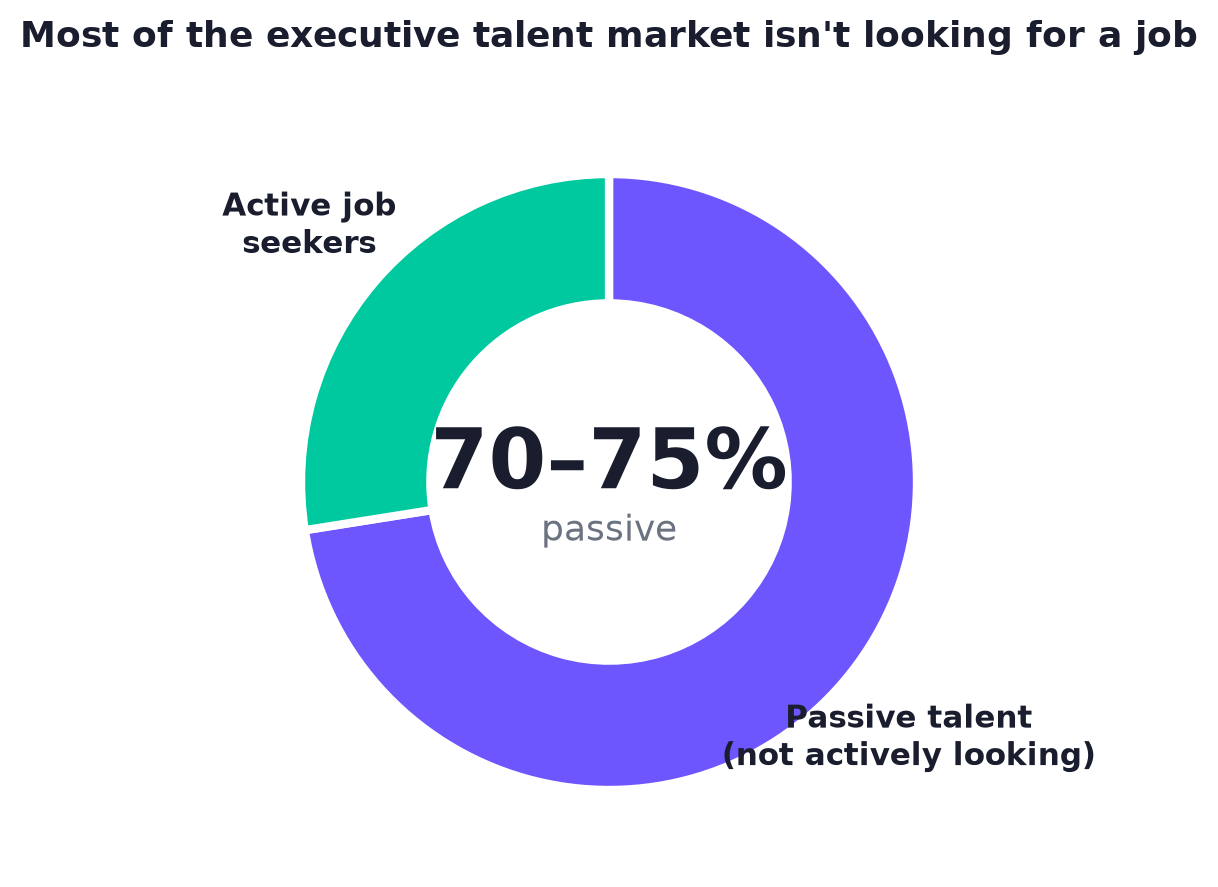
Because the majority of the market isn't looking — job boards structurally miss 70–75% of the field.
LinkedIn's global talent data shows that 70 to 75% of the professional workforce is passive talent — people not actively job-seeking, but open to the right opportunity if reached directly.2 That share only grows more pronounced at the executive level, where a public job posting would rarely reach a sitting CFO, COO, or division president who isn't looking to move.
This is precisely why traditional market mapping — manually researching, cross-referencing, and vetting a target list — remains foundational to the discipline: it's the only way to systematically surface a market that mostly isn't advertising its availability. Pertama Partners describes this manual mapping process as consuming 40 to 80 hours per search, a labor-intensive front-end cost before outreach even begins.3 AI-assisted mapping tools are already compressing that same task to 15 to 20 hours without reducing rigor.3
03 — The Cost of Getting It WrongWhat does a bad executive hire actually cost?
An order of magnitude more than a standard hire — and a failed placement can cost multiples of the role's salary.
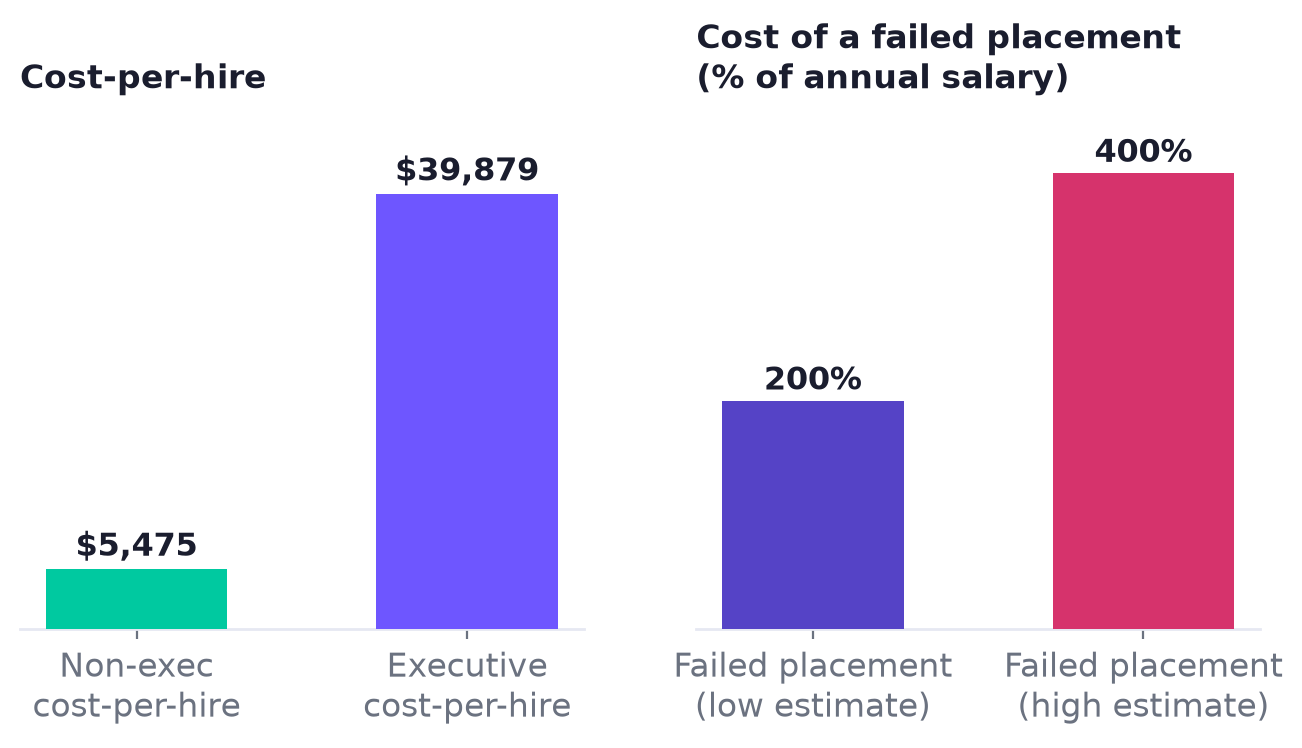
SHRM data cited by Pin puts the average executive cost-per-hire at $35,879, compared to just $5,475 for a non-executive hire — more than six times the cost.6 The stakes compound further if the placement fails: industry estimates put the true cost of a failed executive placement — severance, lost productivity, disruption, and the cost of repeating the search — at 200% to 400% of the role's annual salary.6
Retained search fee structures reflect this risk: typical retained fees run 25% to 35% of the placed executive's first-year compensation, priced to match the complexity, discretion, and rigor the mandate demands — not simply as a placement commission.
04 — The Diversity ImperativeWhy does board and leadership diversity matter to the mandate?
Diverse leadership searches remain underserved relative to demand — and the performance case keeps strengthening.
Women hold just 11% of Fortune 500 CEO roles in 2026, and 27.9% of S&P 500 leadership seats overall, according to Altrata's gender-diversity research.78 McKinsey's long-running diversity research continues to find that companies in the top quartile for executive-team diversity outperform their peers on profitability — reinforcing that diverse slates aren't just a compliance checkbox but a performance lever clients increasingly demand from their search partners.9
05 — ConfidentialityWhy can't executive search work like other recruiting?
Confidentiality isn't a preference in retained search — it's often the entire premise of the engagement.
A large share of retained mandates exist specifically because the client cannot signal the search publicly: replacing an underperforming incumbent, restructuring after a PE transaction, or filling a role before an announcement. Industry guidance on confidential search processes emphasizes that discreet, direct outreach — not public postings — is the only viable channel for these engagements, since a leak can damage the incumbent relationship, unsettle the organization, or tip off competitors.10 AESC's own annual research shows retained search continuing to post record engagement volumes, underscoring how central confidential, high-trust mandates remain to the discipline's growth.11
06 — The MarketHow big is the executive search opportunity?
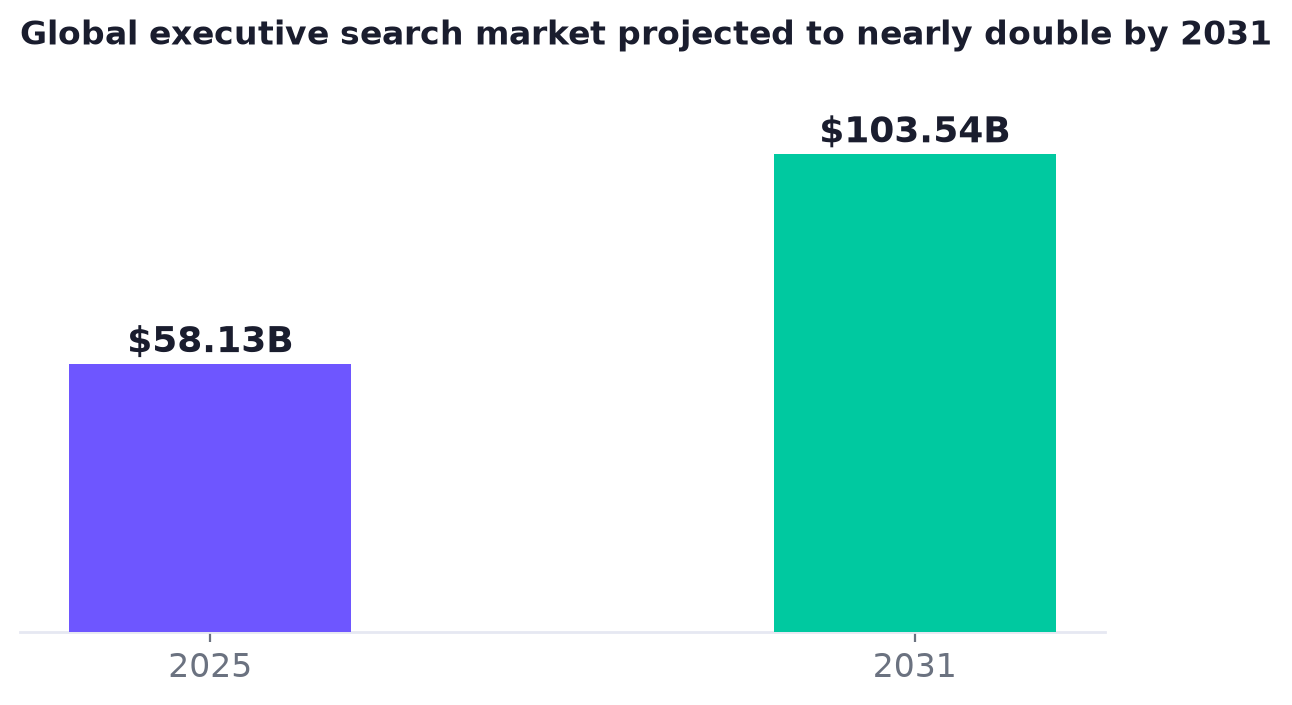
A market on track to nearly double by the early 2030s.
Mordor Intelligence sizes the global executive search market at $58.13B in 2025, projected to reach $103.54B by 2031.12
"70–75% of the workforce isn't looking for a job — which means the search that finds them first, discreetly, wins the mandate."
07 — The PlaybookWhat should an executive search firm do about it?
Five moves separate the firms that will win the next 24 months of senior and confidential mandates:
1. Compress the market-mapping bottleneck. Automate the 40–80 hours of manual research per search so consultants start outreach on day one, not day ten.
2. Build for passive reach by default. With 70–75% of the market not actively looking, sourcing infrastructure has to reach candidates directly — job postings alone will always miss the majority.
3. Protect confidentiality as a design principle. Outreach and research workflows should assume discretion is required, not bolt it on after the fact.
4. Score for fit before the shortlist, not after. With a failed placement costing up to 400% of salary, deeper upfront scoring pays back many times over.
5. Run more concurrent mandates without adding headcount. AI-compressed mapping and outreach let a lean consulting team handle more searches in parallel — directly addressing a market growing toward $103.54B by 2031.12
This is precisely the model UPPER was built to run: continuous, discreet market mapping and passive-candidate engagement that keeps a scored shortlist ready before a mandate is even signed — so a lean search team can move at the speed and discretion senior mandates demand.
Get the designed PDF edition
The full report, formatted as a shareable PDF for your team and clients. Enter your work email and we'll unlock the download.
★ Download the PDFSources
- Clockwork Recruiting, "Executive Search Performance Benchmark Report" (PDF)
- LinkedIn, "Active vs. Passive Candidates: Latest Global Breakdown Revealed"
- Pertama Partners, "AI for Executive Search"
- M&A Executive Search, "The 2025 C-Suite: Decoding 2024's Hiring Data"
- Pin, "Executive Search Strategy" (citing CJPI data)
- Pin, "Executive Search Strategy" (citing SHRM cost-per-hire data)
- Fortune, "How Many Women Are Fortune 500 CEOs?"
- Altrata, "Gender Diversity in Corporate America 2025"
- McKinsey, "Diversity Matters Even More: The Case for Holistic Impact"
- Dilys Search, "How Confidential Executive Searches Work"
- AESC, "Another Record Year"
- Mordor Intelligence, "Executive Search Market Size & Share Analysis"
This report synthesizes third-party research current as of July 2026; figures are attributed to their original sources above. Market-size figures across research vendors diverge by methodology — directional CAGR is emphasized over precise absolute dollar figures. UPPER edition H2 2026 — refreshed semiannually.