Key findings
01 — The DemandWhy is finance and accounting talent still so scarce in 2026?
Because the profession is losing experienced people faster than schools and licensure can replace them.
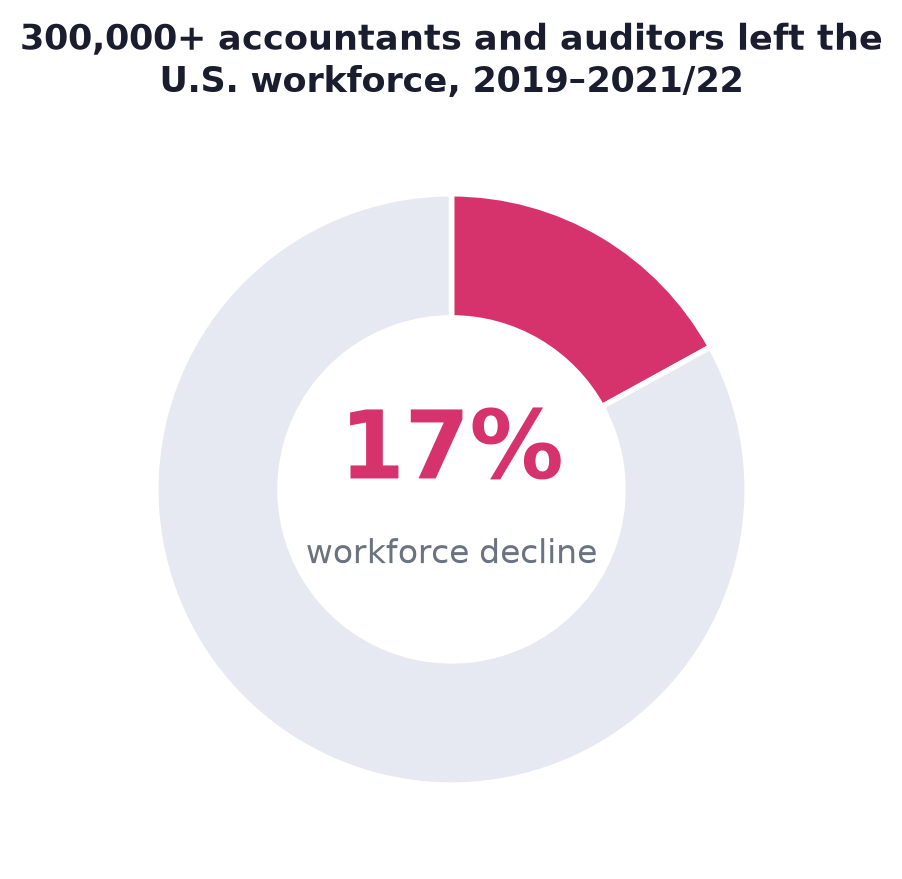
Finance and accounting hiring in 2026 is shaped by a structural supply crisis that predates — and now compounds with — AI-driven change in the function. More than 300,000 accountants and auditors exited the U.S. workforce between 2019 and 2021–2022, a 17% decline reported by the Wall Street Journal using BLS Current Population Survey data.1 Departures have skewed toward experienced staff over time: 82% of workers who exited accounting in 2023 had at least six years of experience, up from 71% in 2021 — meaning the shortage is increasingly a loss of institutional knowledge, not just entry-level attrition.1
Demand is not shrinking to match. BLS projects accountant and auditor employment to grow 5% from 2024 to 2034 — faster than the 3% average for all occupations — with roughly 124,200 job openings projected per year, mostly from replacement needs.7 There are early signs of a rebound: accounting program enrollment rose 12.4% year-over-year in spring 2025, the highest since 2020.5 But degree completions lag enrollment by design, meaning the labor-market effect of this rebound won't be felt for another 2–4 years — leaving a multi-year gap employers must staff through today.
02 — The ClockHow long do finance and accounting roles really take to fill?
Credentials make an already-slow market slower — 41% slower, precisely when deadlines leave no room for delay.
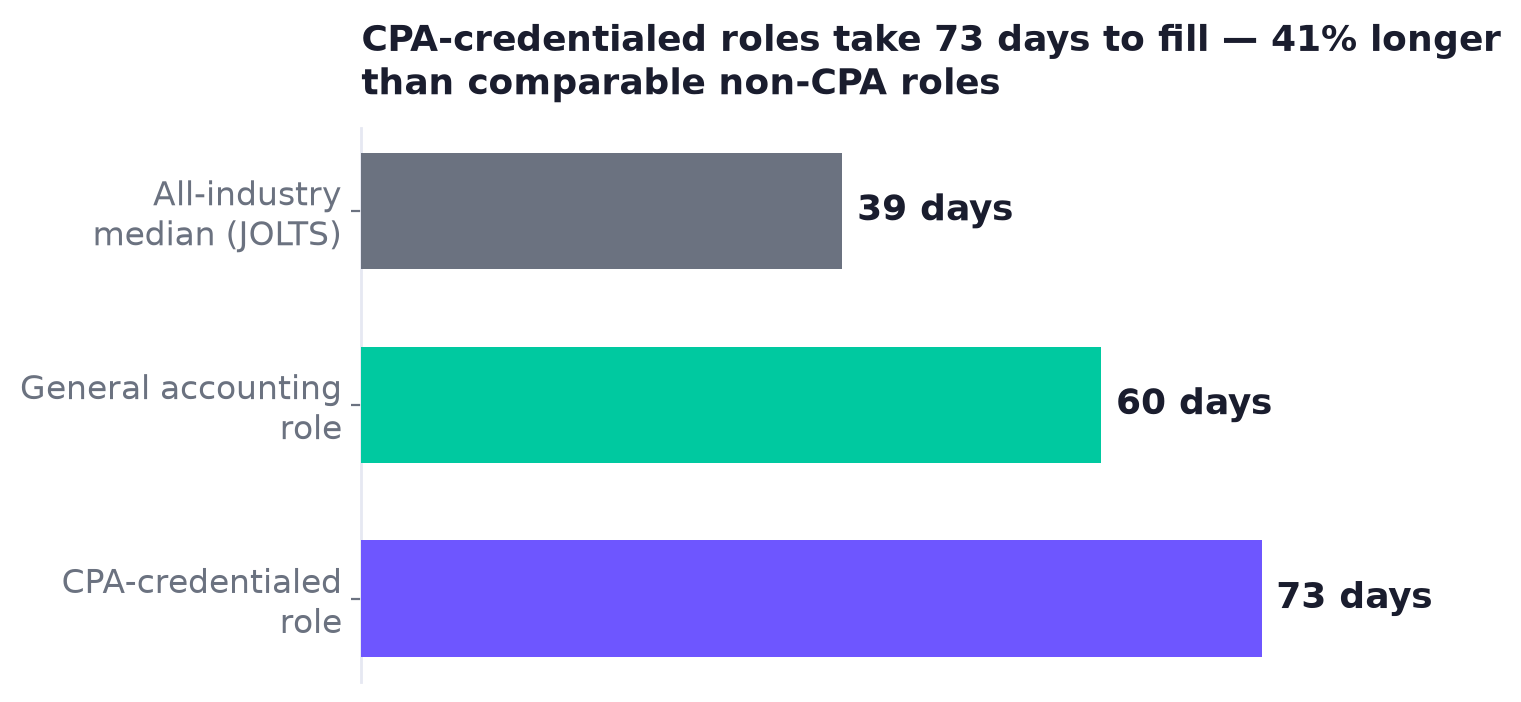
General accounting time-to-hire has climbed past 60 days, but CPA-credentialed roles now average 73 days to fill.9 By comparison, BLS's broader labor-market data (JOLTS) puts average U.S. time-to-fill across all occupations at roughly 36–42 days — underscoring that finance and accounting roles requiring CPA licensure take meaningfully longer than the general labor market to fill.8 Controllers and Tax Accountants are the hardest-to-fill roles, and 87% of CFOs cite the accounting talent gap as their #1 challenge.10
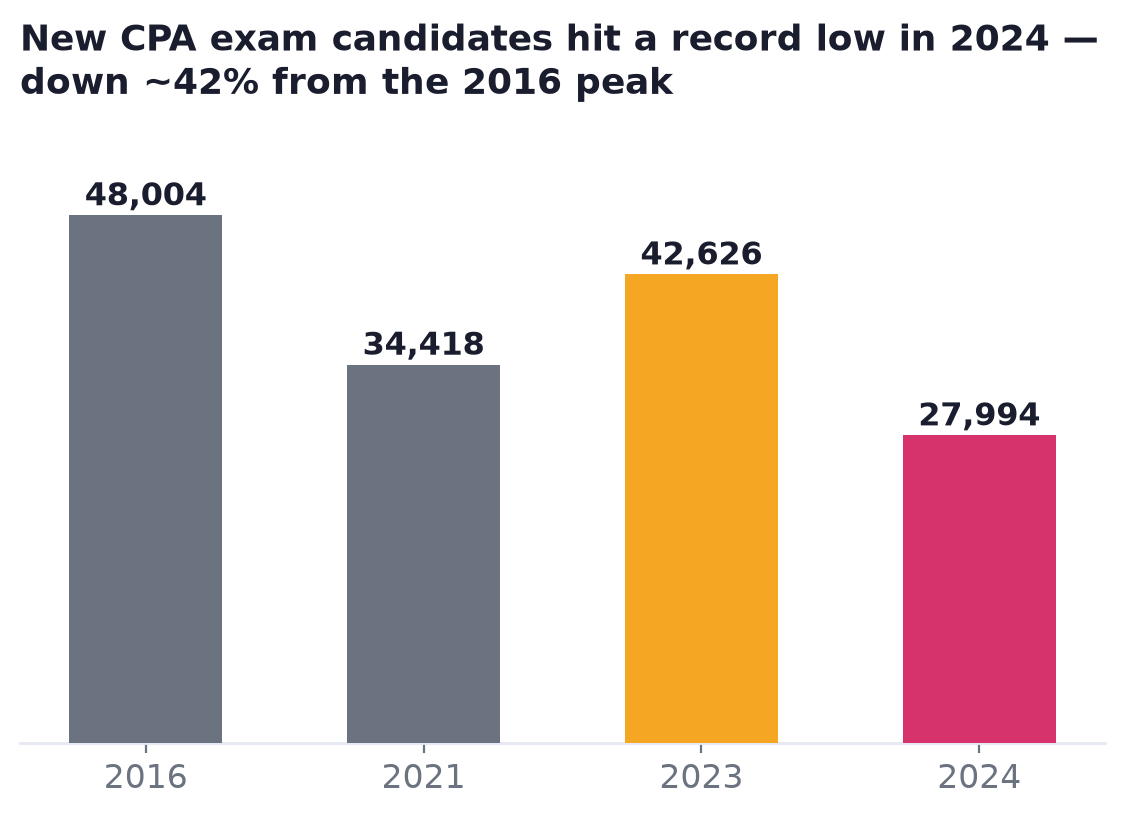
The credential bottleneck traces directly to a shrinking licensed pipeline. New CPA exam candidates fell to a record low of roughly 27,994–28,082 in 2024, down about 42% from the 2016 peak of 48,004.3 CPA exam completions fell from 20,036 in 2023 to just 13,070 in 2024.14
03 — The CycleWhy does finance hiring spike so sharply every year?
Busy season concentrates demand into a few unforgiving weeks — and every competing firm is hiring for the same window.
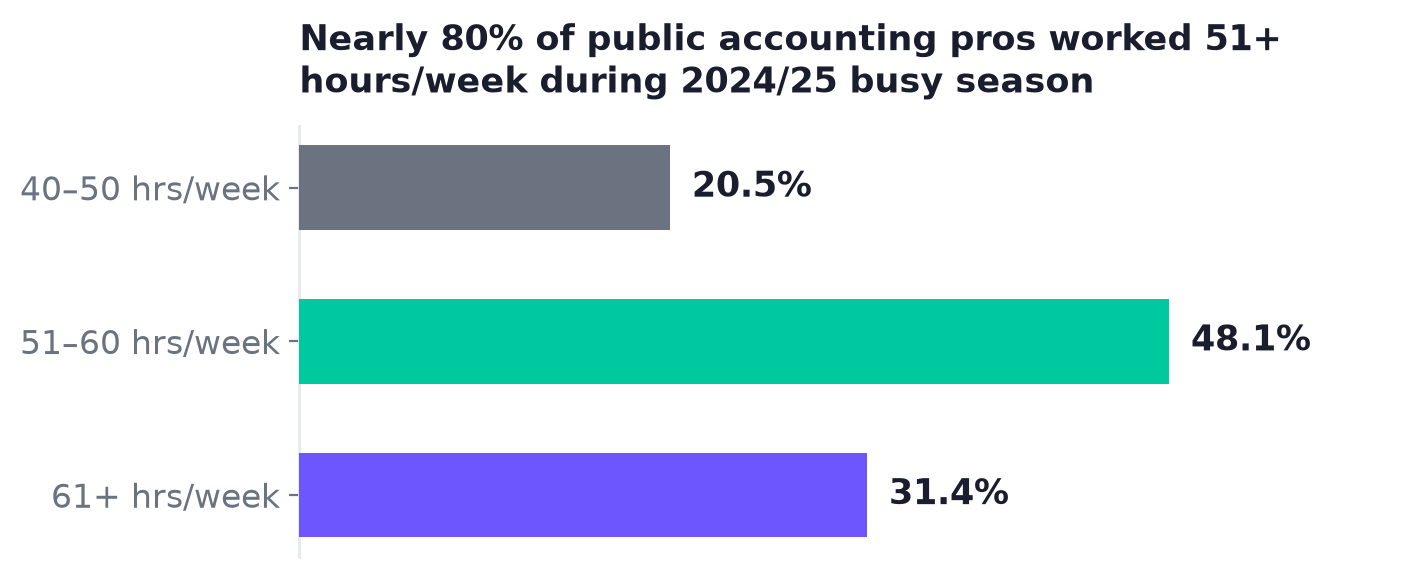
Unlike most white-collar hiring, accounting and audit demand is sharply seasonal, concentrated around tax season (January–April) and quarterly and annual close cycles. In the 2024/25 busy season, nearly 80% of public accounting professionals worked more than 51 hours per week, with Managers and Partners most likely to exceed 70 hours.11 Peer-reviewed research on public accountants found busy-season workload rising to approximately 63 hours a week, with a direct, measurable relationship between workload and job burnout.11
"Finance and accounting staffing cannot be solved with steady-state hiring alone — firms need surge capacity that can be deployed on compressed timelines precisely when the general labor market is least able to supply it."
04 — The Skill ShiftIs AI replacing finance talent or reshaping what firms need?
Neither replacement nor irrelevance — a dual-track requirement spanning traditional depth and AI fluency.
A McKinsey survey of 102 CFOs found 44% used generative AI for more than five use cases in 2025, up from just 7% the prior year, and 65% said their organizations will increase gen-AI investment in 2025.12 Yet the same research cautions that nearly two-thirds of organizations have not yet begun scaling AI across the enterprise — meaning hiring needs to account for both AI-fluent specialists and traditional technical accounting depth simultaneously.12 Generative AI is also cited directly as a factor in professionals leaving the field, as automation displaces "repetitious and tedious work" without a corresponding redesign of career paths.15
The net effect: employers now need to hire simultaneously for traditional technical/regulatory depth (GAAP, tax code, audit standards) that automation has not replaced, and an emerging layer of AI-literate finance talent capable of managing and validating automated close, reconciliation, and reporting processes — a dual-track skill requirement that further narrows the qualified candidate pool.
05 — The Credential BottleneckIs the CPA requirement itself part of the problem?
Yes — and states are actively rewriting licensure rules in direct response.
The number of candidates taking the CPA exam has dropped approximately 27% over the past decade.16 Master's degrees in accounting or taxation — a common CPA-track credential — fell approximately 15% year-over-year in 2023–24, a sharper decline than the 3.3% drop in bachelor's completions.4 States are actively reforming the traditional 150-hour education requirement to add alternative pathways to licensure, in direct response to the pipeline crisis.17 Despite the contraction in graduates, hiring appetite remains strong: firms that hired new graduates in 2024 hired 11,985 total, and 75% of those firms expect to hire the same number or more in 2025.6
06 — The Hidden PoolWhere did all the experienced accountants actually go?
Mostly not out of the workforce — into adjacent finance, tech, and banking roles where job boards won't find them.
A meaningful share of the shortage stems from experienced professionals moving into adjacent tech, banking, and private equity roles rather than leaving the workforce entirely.15 With 82% of recent leavers holding six or more years of experience, many qualified candidates are not on job boards — they moved to adjacent roles and can be re-engaged with the right outreach.1 This is precisely the addressable pool that continuous, multi-channel sourcing is built to reach — not the shrinking pool of active CPA job-seekers everyone else is competing for.
07 — The PlaybookWhat should a finance and accounting staffing desk do about it?
Five moves separate the desks that will win the next 24 months of finance and accounting hiring:
1. Build surge capacity ahead of predictable seasonal peaks. Source contract and interim finance talent months before January–April demand hits, not reactively.
2. Separate credential-gating from skill-gating. Rigorously assess which roles truly require active CPA licensure versus CPA-track or equivalent technical competency.
3. Widen sourcing beyond active job seekers to laterally-departed finance professionals. Most qualified leavers moved to adjacent roles, not out of the workforce.
4. Hire for dual-track capability. Prioritize candidates who can both execute traditional close/audit/tax work and validate AI-automated processes.
5. Treat time-to-fill as a compliance risk metric, not just an HR metric. Finance recruiting should be resourced with the same urgency as the regulatory deadlines it supports.9
This is precisely the model UPPER was built to run: autonomous, compliant, multi-channel sourcing that scores candidates against the requirement and starts outreach in one loop — so a lean finance staffing team can submit qualified, credential-verified candidates before the deadline, not after.
Get the designed PDF edition
The full report, formatted as a shareable PDF for your team and clients. Enter your work email and we'll unlock the download.
★ Download the PDFSources
- Wall Street Journal — "Why So Many Accountants Are Quitting" (2022)
- AICPA & CIMA — 2025 Trends Report
- Journal of Accountancy — The accounting graduate pipeline (2025)
- AICPA & CIMA — Undergraduate Enrollment Rises for Third Straight Year
- AICPA & CIMA — Accounting Firms Report Strong Hiring Outlook
- BLS Occupational Outlook Handbook — Accountants and Auditors
- BLS — Job Openings and Labor Turnover Survey
- Talentfoot — How the CPA Shortage Is Extending Time-to-Fill
- Personiv — Spring 2025 CFO Pulse Survey
- Distinct Recruitment US — Busy Season 2025 Survey
- McKinsey & Company — How finance teams are putting AI to work today
- Atlas CPA Index — The CPA Candidate Pipeline in 2026
- Forbes — AI Is Taking Over Accounting Jobs As People Leave The Profession
- Auxis — There's a Shortage of Accountants. What Can You Do About It?
- California Board of Accountancy — Report on Long-Term Licensing Data Trends
This report synthesizes third-party research current as of July 2026; figures are attributed to their original sources above. Some forward projections are inherently uncertain. UPPER edition H2 2026 — refreshed semiannually.