Key findings
01 — The DemandWhy is clinical hiring structurally hard in 2026?
Because replacement demand alone outstrips workforce growth — this is a multi-year overhang, not a cyclical blip.
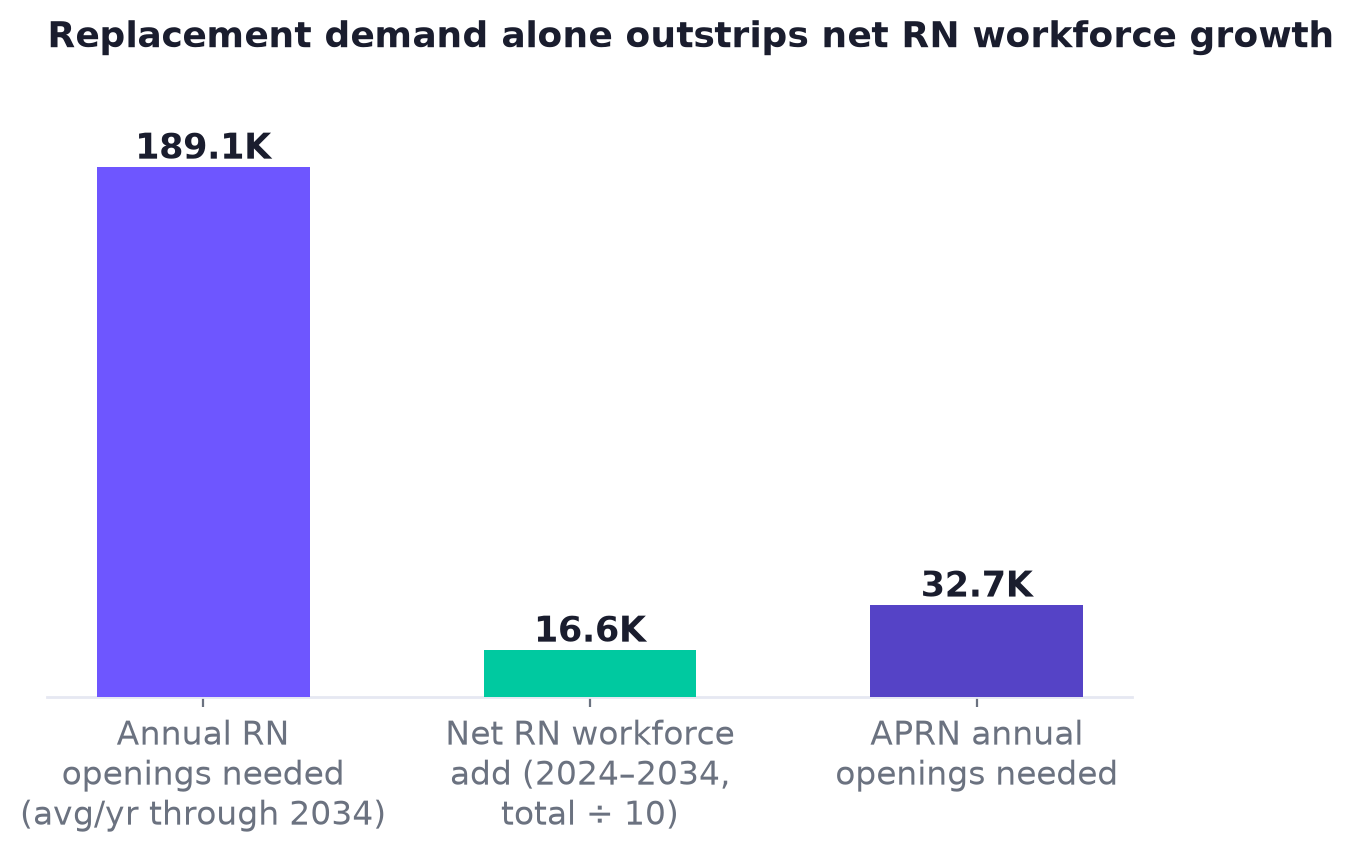
The U.S. is projected to need 189,100 new RN positions filled every year through 2034, while the RN workforce itself is projected to grow just 5% over the decade — from 3.39 million in 2024 to 3.56 million in 2034, a net add of only 166,100 nurses against that annual opening count.1 HRSA's federal workforce modeling separately projects a shortage of 267,330 full-time RNs by 2028.1 Demand for advanced practice roles is accelerating even faster: APRNs (nurse practitioners, CRNAs, midwives) need ~32,700 new hires annually, growing 35% from 2024–2034.1
The bottleneck isn't only demand — it's capacity to train. U.S. nursing programs turned away 92,672 qualified applications in 2025 (up from 65,766 in 2023) due to insufficient faculty, clinical sites, and classroom space, with 1,588 full-time nurse faculty vacancies nationally.1 Meanwhile the population needing care is growing: Americans 65+ will rise from 58 million in 2022 to 82 million by 2050, even as more than 1 million RNs are projected to retire by 2030.1
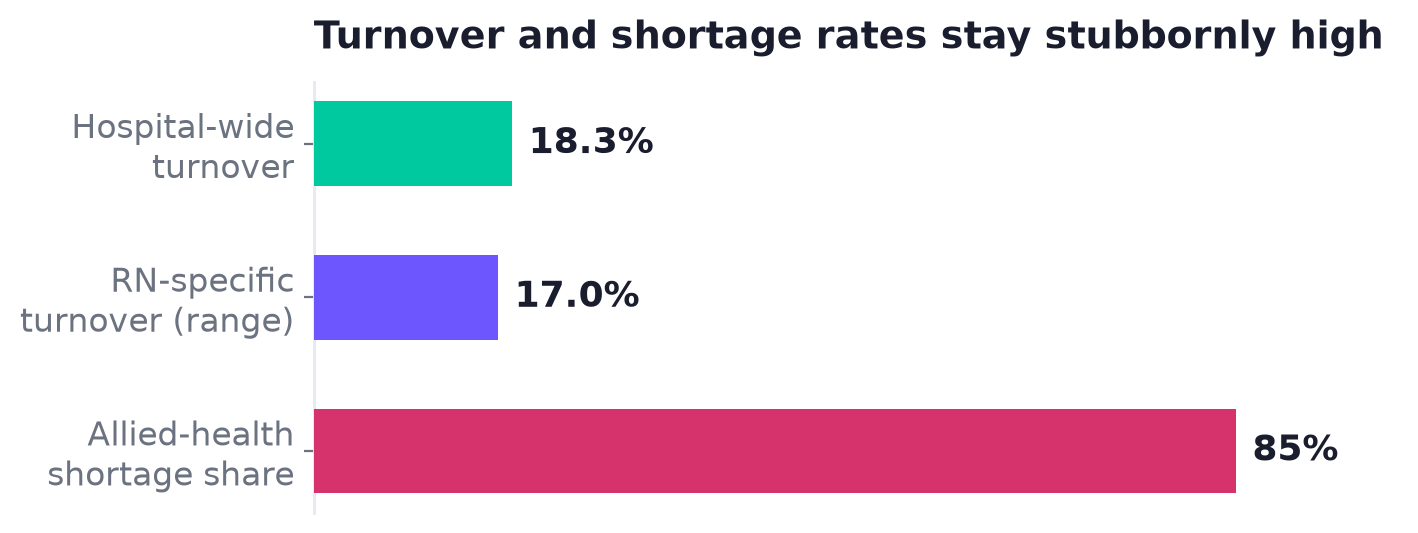
And it's not just nursing. HRSA's "State of the U.S. Health Care Workforce 2025" separately projects a shortage of 141,160 FTE physicians by 2038, plus 33,220 FTE dental hygienists and up to 19,860 FTE general dentists.3 Allied health is under the same pressure: 85% of surveyed healthcare facilities report at least moderate shortages in roles like radiologic technicians, physical therapists, and lab technicians.5
02 — The ClockHow long does it really take to fill a clinical role?
Roughly three months for an experienced RN — and specialized clinical roles can run far longer.
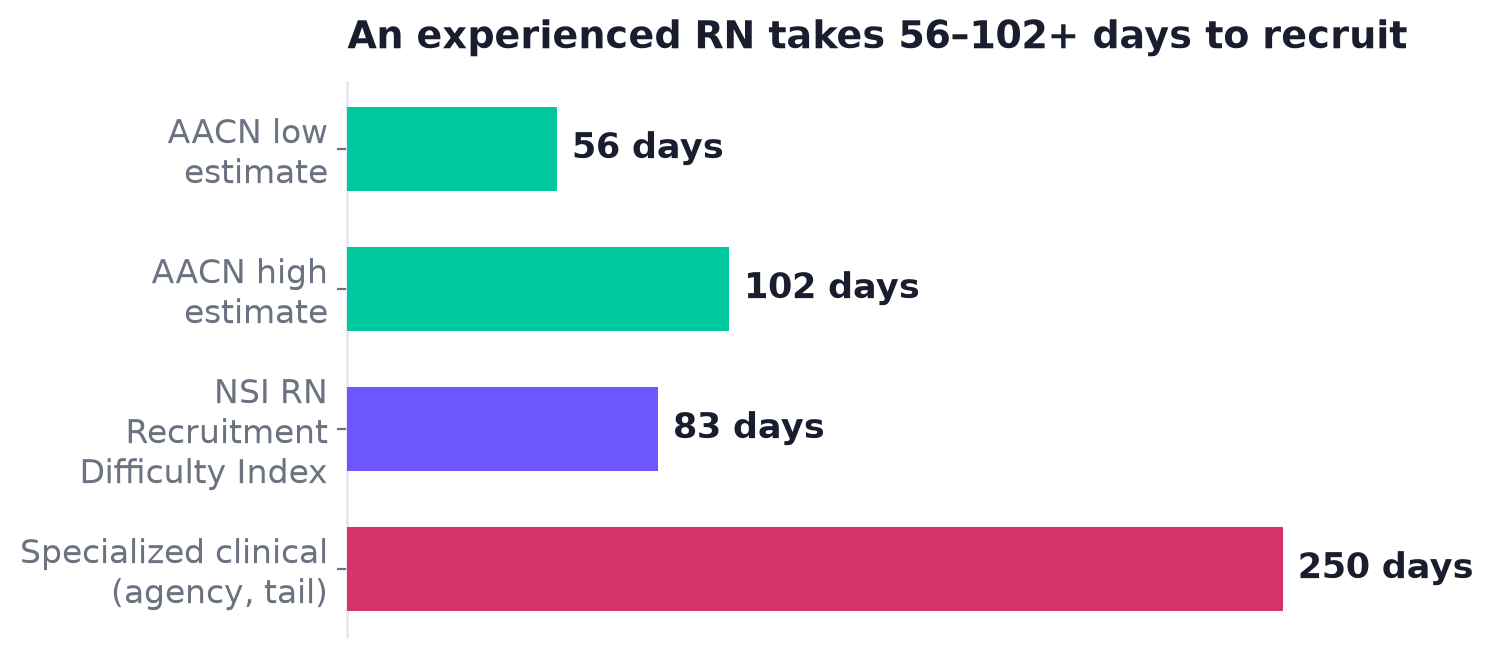
NSI's 2025 National Health Care Retention & RN Staffing Report puts the average at 83 days — its "RN Recruitment Difficulty Index" — describing it as "approximately 3 months" to recruit an experienced RN.2 AACN's own fact sheet cites a slightly different range of 56 to 102 days.1 Cross-industry benchmarking from Staftr's 2025 Staffing Speed Report finds healthcare consistently ranks among the slowest industries to fill: general healthcare roles average 49 days direct-hire versus a 36–44 day all-industry average, while specialized clinical positions can stretch to 250 days.7 Staffing agencies compress general healthcare roles to 17–20 days — but the 250-day tail for hard-to-fill specialties persists even through agencies.7
The financial case for speed is direct: NSI estimates every RN successfully hired instead of covered by contract labor saves an institution roughly $79,100, and one modeled scenario found replacing 20 travel nurses with permanent staff saved an institution $1,582,000.2 Each 1-percentage-point change in RN turnover moves the average hospital's costs by an additional $289,000 per year.2
03 — The Market ShiftWhat's happening to the travel-nurse market?
The market is stabilizing, not shrinking — and margin pressure is pushing agencies toward efficiency over rate arbitrage.
Staffing Industry Analysts sized the U.S. healthcare staffing market at $39.4B in 2025, breaking out as travel nursing ($14.2B), allied health ($9.8B), locum tenens ($9.6B), and per diem nursing ($4.5B) — travel nursing remains the largest sub-segment, but growth has normalized from pandemic-era peaks.9 Travel RN wage data from Vivian Health shows a regionally fragmented market: West +0.70% QoQ, Midwest +0.24%, Northeast −0.09%, South −0.88% in Q1 2025 — localized, supply/demand-driven rate-setting rather than uniform decline.8
For agencies, the implication is clear: as rate premiums compress and normalize regionally, margin pressure pushes staffing firms toward efficiency — faster placements, lower cost-per-hire — rather than rate arbitrage. That's a direct opening for AI-driven sourcing speed as a competitive lever.
04 — The Compliance BurdenWhy does credentialing slow everything down?
Complex, fragmented credentialing is the sector's stated reason for lagging on AI — and the biggest opportunity for a compliant AI-native sourcing layer.
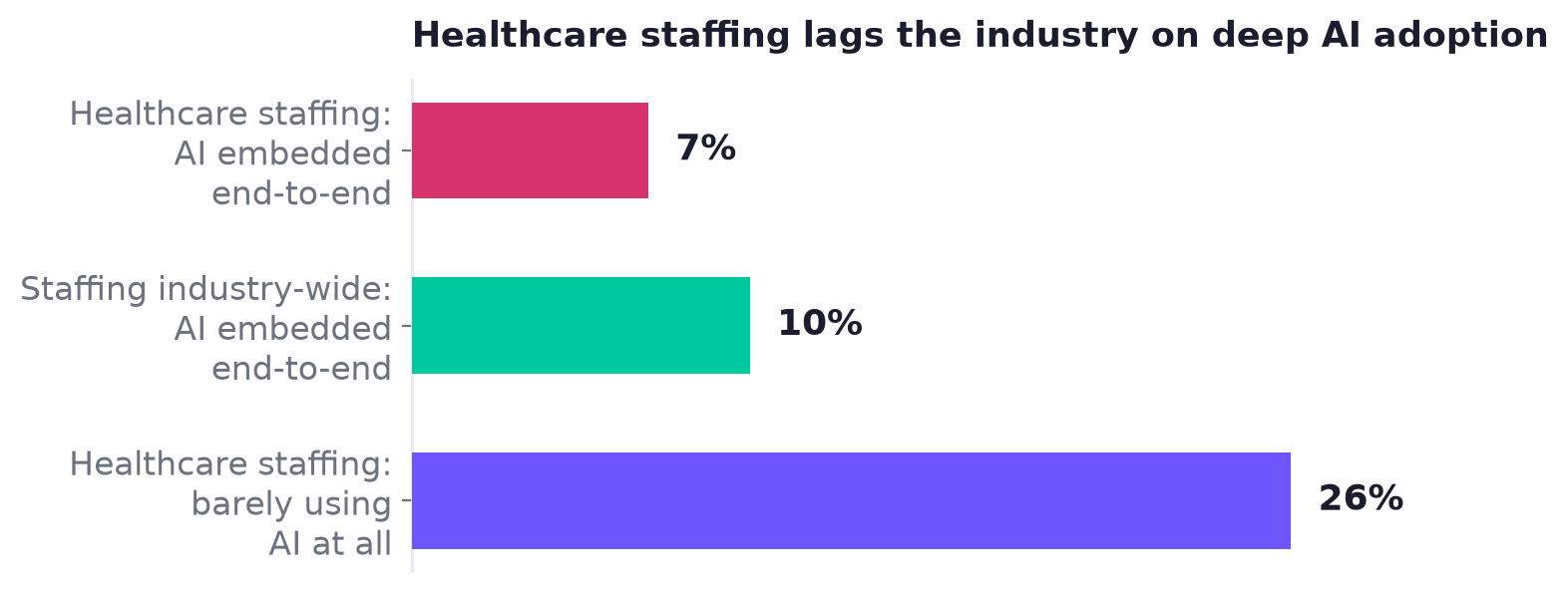
Healthcare staffing firms cite complex credentialing, strict regulations, and fragmented data as the primary reasons the sector trails the broader staffing industry in AI adoption — only 7% of healthcare staffing firms have AI embedded throughout their entire workflow versus 10% industry-wide, and 26% report not using AI extensively at all versus 20% industry-wide.10 Despite the lag, firms that do use AI cite identifying better candidates faster and screening a higher volume of candidates as the top two benefits — directly tied to easing credentialing and compliance friction.10
Revenue growth is rebounding even amid these constraints: 36% of healthcare staffing firms reported revenue growth in 2025 (up from 29% in 2024), and 8% grew revenue more than 25% year over year — showing real appetite for firms that can operationally scale despite compliance overhead.10
05 — The Attrition CrisisHow much is burnout accelerating the shortage?
Attrition intent jumped sharply in a single year — and understaffing is now a documented patient-safety issue, not just a cost problem.
23% of nurses said they were very likely to leave their role in 2024, up sharply from 8% in 2023 — one of the largest single-year jumps in attrition intent on record for the profession.6 AACN's 2025 data shows 24% of nurses considering leaving, with 60% reporting feeling overwhelmed and 53% reporting burnout.1 Reasons cited for leaving: planned retirement (39%), burnout (26%), insufficient staffing (21%), family obligations (18%).1
"Understaffed units showed roughly 6% higher mortality risk in a study of nearly 198,000 patients — attrition in healthcare isn't just a cost problem, it's a patient-safety problem."
The clinical stakes raise the willingness to pay for faster, higher-quality hiring: peer-reviewed nurse-staffing research cited by AACN found a 10-percentage-point reduction in RN staffing is associated with 7% higher odds of in-hospital death and 1% higher odds of readmission.1
06 — The PlaybookWhat should a healthcare staffing agency do about it?
Five moves separate the agencies that will win the next 24 months of clinical and allied-health hiring:
1. Compress the 83-day RN Recruitment Difficulty Index. Run always-on autonomous sourcing against passive, credentialed clinical talent pools — attacking the single biggest lever in the NSI benchmark.
2. Close the AI adoption gap. With only 7% of healthcare staffing firms deeply AI-adopted versus 10% industry-wide, early movers gain a durable speed advantage over the 26% still working manually.
3. Automate compliant, high-volume outreach. With 189,100 annual RN openings nationally, AI-orchestrated, compliance-aware messaging lets a single recruiter cover far more credentialed candidates.
4. Reduce the cost of turnover. At $61,110 per departing bedside RN, even modest improvements in fill speed and candidate-role fit pay back quickly.
5. Reach the allied-health long tail. With 85% of facilities reporting shortages across dozens of specialties, sourcing that scales horizontally — rather than needing a dedicated sourcer per specialty — targets the sector's most fragmented pain point.5
This is precisely the model UPPER was built to run: autonomous, compliance-aware, multi-channel sourcing that screens for credential and licensure status before a candidate is ever surfaced — so a lean clinical-staffing team can move at the speed a structural shortage demands.
Get the designed PDF edition
The full report, formatted as a shareable PDF for your team and clients. Enter your work email and we'll unlock the download.
★ Download the PDFSources
- AACN, "Nursing Shortage Fact Sheet"
- NSI Nursing Solutions, "2025 NSI National Health Care Retention & RN Staffing Report"
- HRSA Bureau of Health Workforce, "State of the U.S. Health Care Workforce, 2025" (PDF)
- Becker's Hospital Review, "85% of health facilities short on allied health workers" (AMN Healthcare survey)
- Healthcare Workforce Coalition, "America's Healthcare — By the Numbers" (PDF)
- Staftr, "The 2025 Staffing Speed Report" (PDF)
- Vivian Health, "Quarterly Travel RN Wage Trends (Jan–March 2025) for Employers"
- Staffing Industry Analysts (SIA) data via Healthcare Workforce Logistics, LinkedIn
- Bullhorn, "GRID 2026 Industry Trends Report: Healthcare Spotlight"
- Grand View Research, "Healthcare Staffing Market Size & Share Report, 2026–2033"
- Precedence Research, "Healthcare Staffing Market Size to Hit USD 87.61 Bn by 2035"
This report synthesizes third-party research current as of July 2026; figures are attributed to their original sources above. Market-size figures across research vendors diverge by methodology — directional CAGR is emphasized over precise absolute dollar figures. UPPER edition H2 2026 — refreshed semiannually.