Key findings
01 — The ParadoxWhy is insurance hiring growing and shrinking at once?
Overall headcount is stable, but the workforce underneath it is aging out at a scale no other major industry faces.
Insurance presents a paradox: overall industry employment is broadly stable to growing, even as the workforce underneath it ages out at scale. BLS data show total insurance carrier and related-activities employment at roughly 3.02 million jobs as of December 2025, up from 3.01 million a year earlier.12 The Jacobson Group/Aon Q3 2025 study similarly found 53% of insurers planning to increase staff in the next 12 months (driven by a 60% figure in Life/Health), while only 14% plan reductions.3
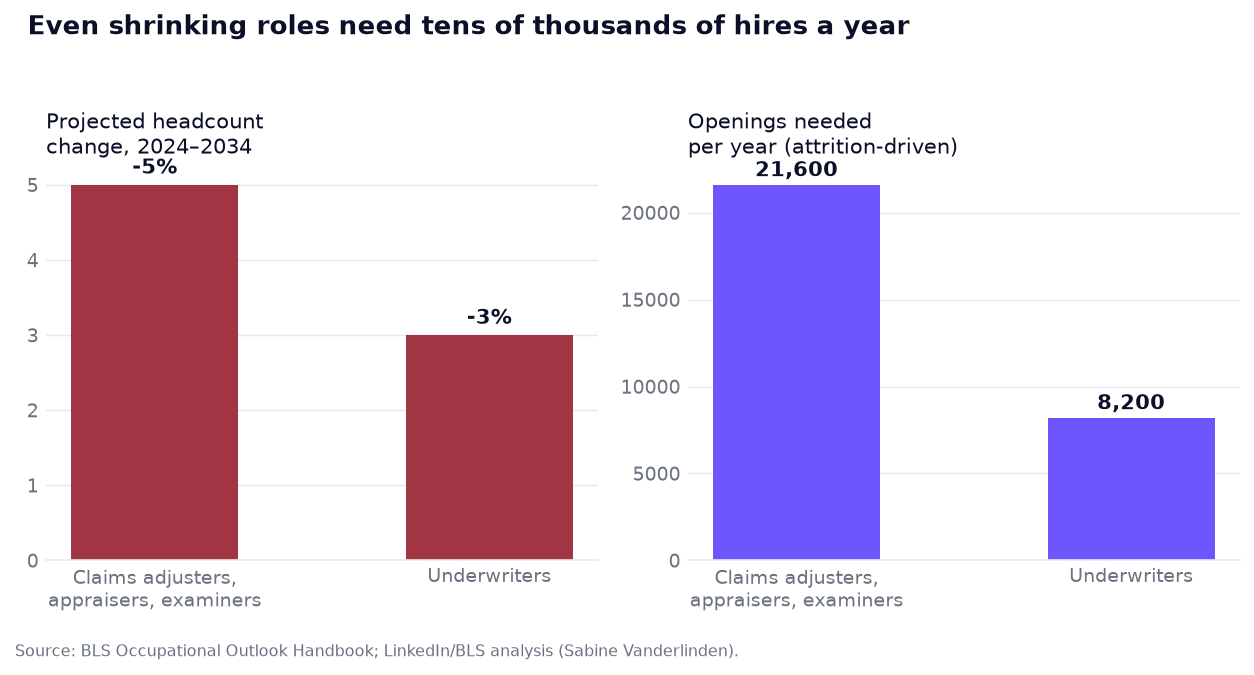
But this stability sits atop a demographic cliff. Even in occupations projected to decline in headcount, replacement demand remains enormous: claims adjusters, appraisers, examiners, and investigators are projected to shrink 5% from 2024–2034 (a loss of 18,900 jobs) — yet the industry will still need to fill approximately 21,600 openings annually over the decade, driven entirely by retirements and occupational transfers.6 Underwriters show the same dynamic: a projected 3% headcount decline masks the need to fill roughly 8,200 openings per year.7
02 — The Retirement CliffHow steep is insurance's demographic problem, really?
No other major U.S. industry faces as acute a demographic cliff as insurance — and it's consistent across every source.
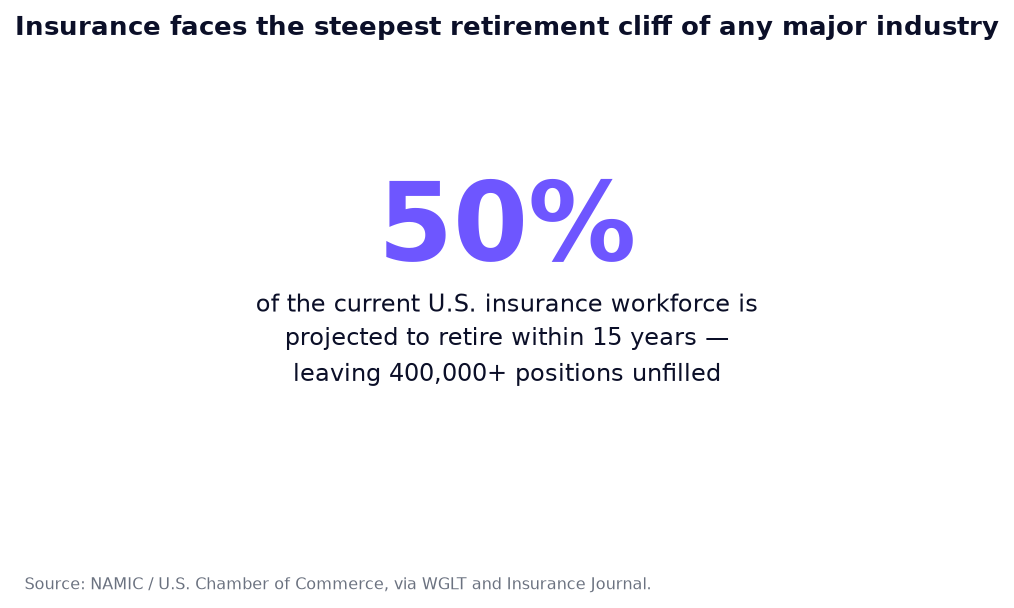
NAMIC/U.S. Chamber of Commerce data project 50% of the current insurance workforce retiring within 15 years, with more than 400,000 open positions left unfilled.1 A Slayton Search Partners analysis puts a nearer-term marker at nearly 400,000 insurance professionals retiring by the end of 2026.11 The aging concentration is worst at the top of the expertise pyramid: roughly one in four underwriters is over age 50, and the average insurance professional is in their mid-50s.11
A 2025 APQC/eGain survey found organizations expect an average of 51% of their workforce to retire or leave within five years — closely corroborating the "silver tsunami" figure from an independent knowledge-management research angle.4
03 — The BottleneckWhy can't insurers just hire their way out of it?
The entry pipeline isn't remotely close to replacing who's leaving — and the hardest roles have the thinnest supply.
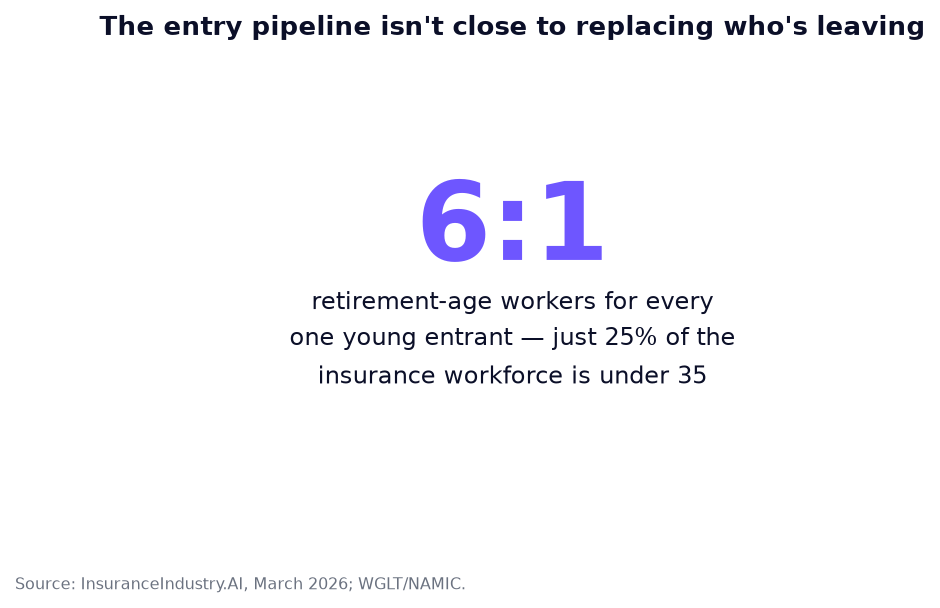
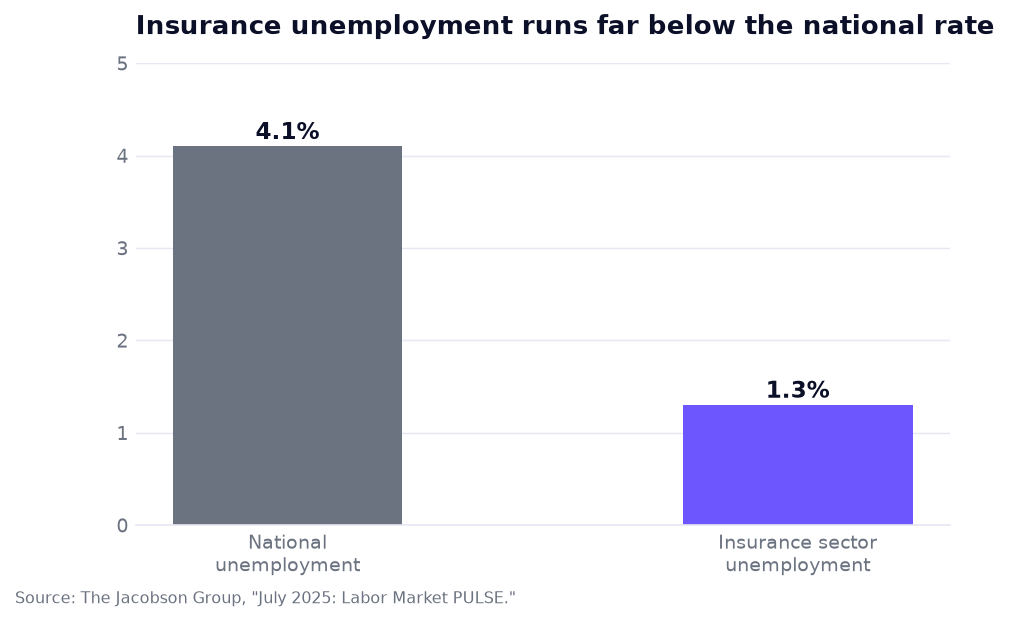
Only 25% of the current insurance workforce is under age 35, while the entry-to-exit ratio is estimated at roughly six retirement-age workers for every one young entrant.4 While overall insurance unemployment runs well below the national average — the sector's rate has dipped as low as 1.3% in recent readings versus a national rate near 4.1% — the hardest roles remain stuck: actuarial, executive, and analytics positions have topped the "hardest to fill" list in the Jacobson Group/Aon survey for five consecutive iterations.4
Actuarial unemployment stayed below 1% throughout 2025, underscoring persistent scarcity in a field with essentially no slack.5
04 — The Leaky PipelineWhy does entry-level attrition make everything worse?
Even the entry-level pipeline that does exist mostly doesn't survive its first year.
Industry estimates cited alongside NAMIC figures suggest 90% of new insurance agents quit within their first year, and up to 95% leave within five years.13 A broader claim circulating in industry commentary — that a large majority of Gen Z has never considered an insurance career — is directionally consistent with these retention figures but lacks a traceable primary source, so it is not cited here as a verified statistic.
Compounding the pipeline gap, insurtech and digital skills shortfalls are widening: a 2025 industry survey found 70% of leaders say business performance is suffering because employees lack necessary competencies, only 1 in 3 insurers have a formal AI training program, and fewer than 20% of cyber insurance underwriters have formal cybersecurity training.9
"The sector has perhaps three to five years before the combined effects of mass retirement and AI transformation make this problem exponentially harder to solve."
05 — The Real CrisisIs this a headcount problem or a knowledge problem?
Senior underwriters and actuaries carry decades of tacit risk-pricing judgment that doesn't transfer through a job posting.
The insurance talent crisis is fundamentally a knowledge-transfer crisis, not merely a staffing one — it has to be captured, structured, and handed to successors deliberately.4 McKinsey's insurance talent research frames human capital, not financial capital, as the scarcest resource in the industry today, and projects the need for technological skills across the workforce to rise 55% through 2030 while basic cognitive/clerical skill needs decline 15%.10
06 — The PlaybookWhat should an insurance talent team do about it?
Five moves separate the carriers and brokers that will win the next 24 months of insurance hiring:
1. Build succession pipelines years ahead of retirement, not reactively. With a ~6:1 retirement-to-entrant ratio and 400,000+ projected vacancies, map and pipeline candidates for actuarial, underwriting, and claims roles well before incumbents give notice.
2. Widen the aperture beyond traditional actuarial/underwriting credential pools. With actuarial unemployment under 1%, identify adjacent-skill candidates — data science, quantitative finance, risk analytics — who can be credentialed into these tracks.
3. Target technology, underwriting, and claims simultaneously. These are consistently flagged as the industry's top three hiring priorities.3
4. Solve the entry-level retention leak, not just the top-of-funnel search. Given extremely high first-year attrition among new agents, optimize matching for role/culture-fit signals that predict retention, not just credential match.
5. Close the digital/AI skills gap through targeted sourcing. Surface candidates who already combine domain insurance knowledge with digital/AI fluency — the exact hybrid profile the industry lacks internally.
This is precisely the model UPPER was built to run: autonomous, always-on sourcing that builds succession pipelines for actuarial, underwriting, and claims roles years ahead of the retirement wave — so carriers and brokers stop scrambling and start planning.
Get the designed PDF edition
The full report, formatted as a shareable PDF for your team and clients. Enter your work email and we'll unlock the download.
★ Download the PDFSources
- WGLT — "Q&A: Insurers Group Warns Of 'Retirement Cliff' In U.S. Workforce" (NAMIC data)
- Insurance Journal — "That Insurance Talent Crisis? It's a Global Knowledge Opportunity" (March 2024)
- The Jacobson Group — Q3 2025 Insurance Labor Market Study
- InsuranceIndustry.AI — "Your Best Underwriters are Leaving. What Happens to What They Know?" (March 2026)
- DW Simpson — "2026 Market Trends in Actuarial Recruiting" (Feb 2026)
- Bureau of Labor Statistics — Occupational Outlook Handbook, Claims Adjusters
- LinkedIn (Sabine Vanderlinden) — "The US Insurance Talent Gap" (BLS analysis)
- RSM UK — "The future of insurance: an ageing workforce and a growing talent gap" (Feb 2026)
- Eliot Partnership — "How Insurance Leaders Are Tackling Skill Gaps in 2025" (May 2025)
- McKinsey & Company — "Transforming the talent model in the insurance industry"
- Slayton Search Partners — "The Insurance Industry Retirement Crisis: How to Prepare" (Feb 2026)
- PIA Western Alliance — "Insurance Jobs — Negatives & Positives" (BLS data, Jan 2026)
- U.S. Department of the Treasury / American College FACI — Financial Inclusion presentation (June 2024)
This report synthesizes third-party research current as of July 2026; figures are attributed to their original sources above. The claim that a large majority of Gen Z has never considered an insurance career circulates in industry commentary but lacks a traceable primary source and is not presented as verified. UPPER edition H2 2026 — refreshed semiannually.