Key findings
01 — The DemandWhy is technical talent still so hard to hire in 2026?
Because demand for high-complexity technical skills keeps outrunning supply — and the roles that matter most take the longest to fill.
For a decade, the conventional wisdom was that a cooling tech sector would loosen the talent market. It hasn't — not where it counts. U.S. tech unemployment sat at 2.8% in mid-2025, well below the national rate of roughly 4.1–4.3%,6 and the Bureau of Labor Statistics projects computer and mathematical occupations to grow 10.1% through 2034 — more than three times the all-occupation average.3 Software developers alone are projected to grow 15–16%, adding on the order of 270,000–300,000 roles.1
The scarcity is sharpest in the specializations every company now needs at once. The global cybersecurity workforce gap reached 4.8 million unfilled positions in 2024 — nearly half of total need — and it widened 19% in a single year.9 Data-science roles are projected to grow by roughly a third.3 This is not a market with slack; it's a market where the hardest roles are getting harder.
02 — The ClockHow long do technical roles really take to fill?
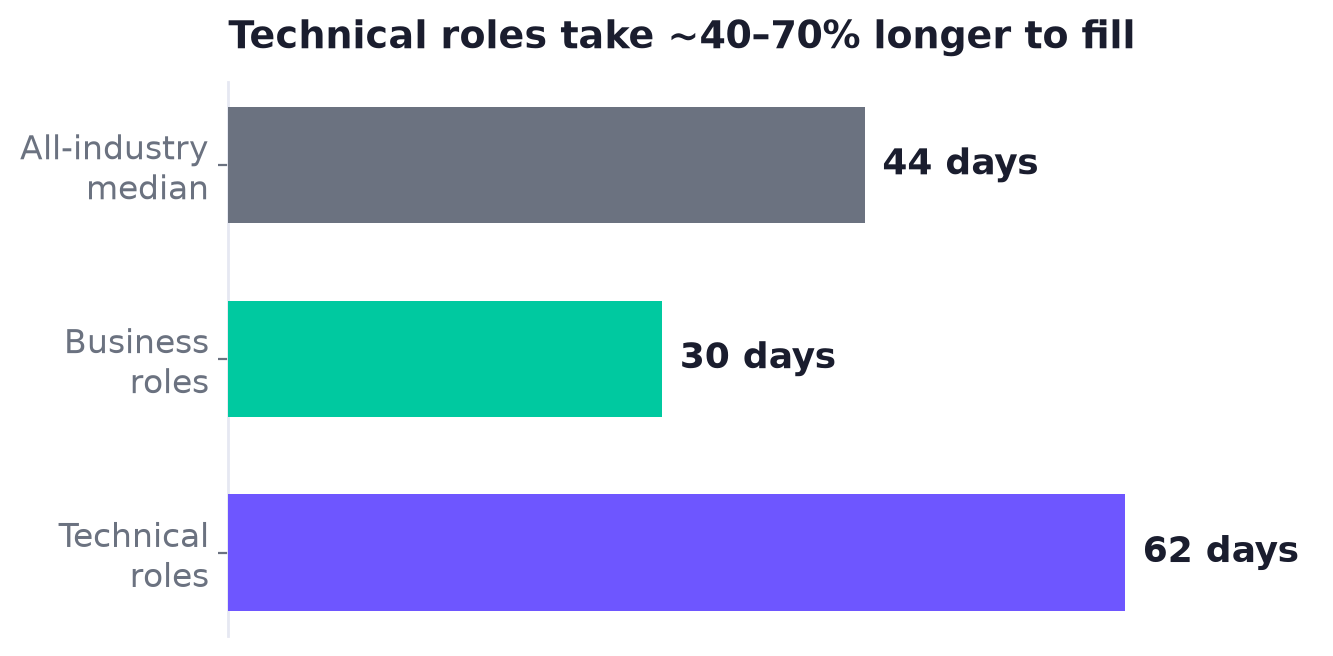
Technical roles take ~40–70% longer than average — and top engineers are gone in about ten days.
Speed is the whole game, and technical hiring is structurally slow. SHRM's 2025 benchmarking puts screening and interviewing at 8–9 days each, before a single technical loop.10 Ashby's analysis of 54M+ applications finds technical roles run about 40 days median time-to-hire versus ~30 for business roles, plus an extra interview stage.14 Aggregated benchmarks put software-engineering time-to-fill around 60–62 days — 40–70% above the cross-industry median.10
The cruelty of the math: the best candidates don't wait. Once top technical talent begins actively looking, the window before they're hired elsewhere is roughly ten days. A 60-day process aimed at a 10-day window explains why so many searches quietly fail — not for lack of candidates, but for lack of speed.
03 — The DisruptionIs AI reducing or increasing demand for technical talent?
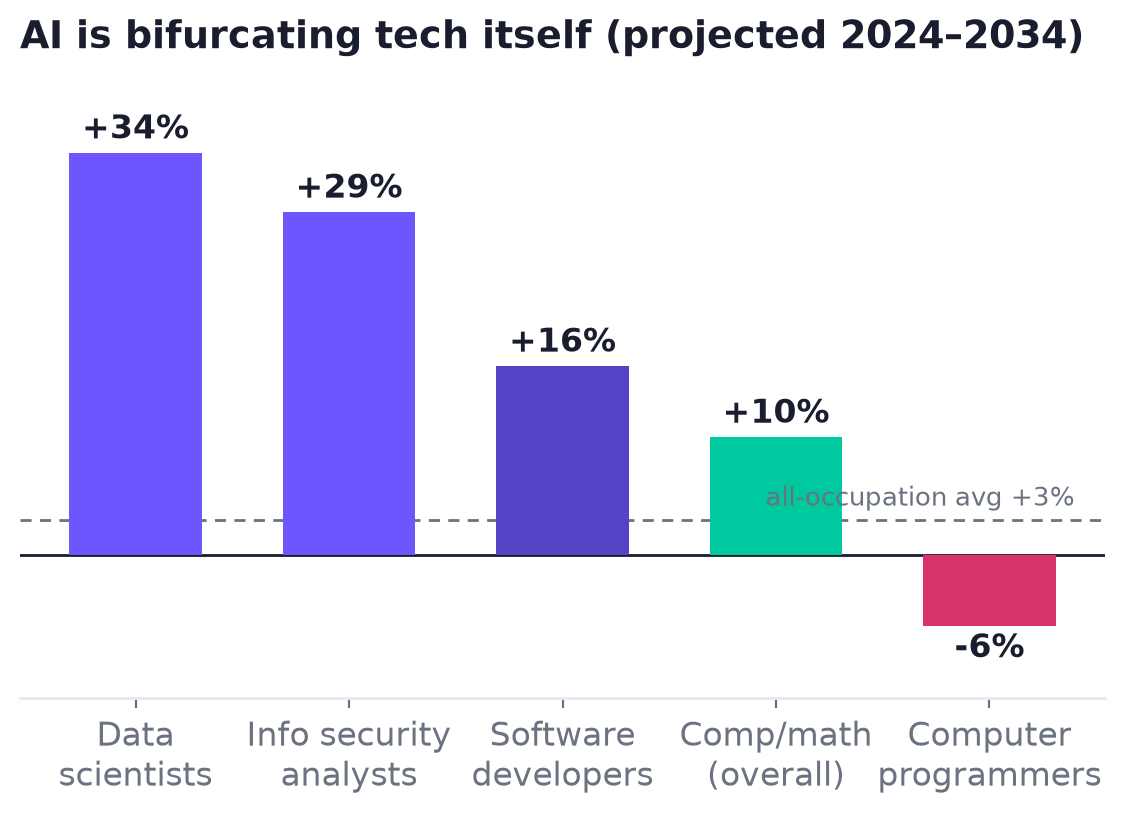
Both — AI is bifurcating tech itself, lifting high-complexity roles while compressing routine coding.
The headline "AI replaces engineers" is wrong; the truth is more useful. BLS projects information security analysts to grow ~29% and data scientists ~34%, while routine computer-programmer roles decline 6%.4 AI Engineer was LinkedIn's #1 fastest-growing U.S. title two years running, and CompTIA recorded nearly 125,000 active AI-related postings in a single month.8 AI isn't shrinking the market — it's redrawing the map of which skills command a premium.
For agencies, this is opportunity: the roles growing fastest are exactly the ones clients cannot fill alone. But it also raises the bar — sourcing has to find specialized, scarce, and largely passive talent, not just anyone with a résumé.
04 — The Passive MajorityWhere is the best technical talent actually hiding?
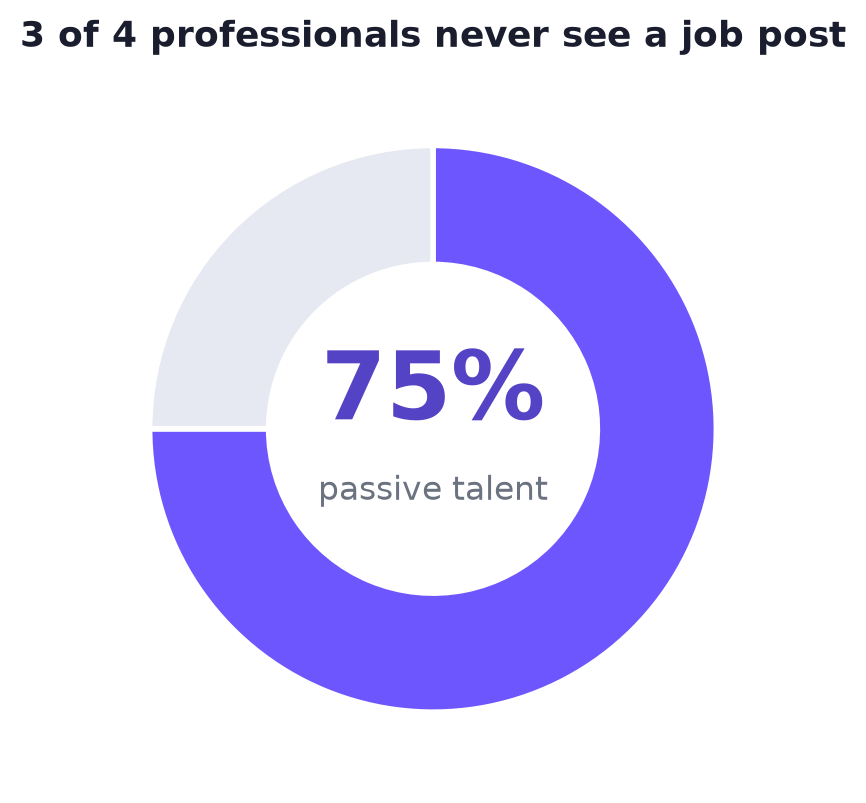
Three out of four professionals are passive — the post-and-pray funnel misses the majority of great engineers.
LinkedIn's long-running research holds: 75% of the workforce is passive — employed, not actively looking — and only about a quarter are active job-seekers at any moment.16 Job boards still generate ~90% of applications but only about half of hires; sourced candidates are ~8x more likely to be hired than inbound applicants.12
"You cannot post your way to a senior engineer. The person you want isn't reading job boards — they're shipping code for someone else."
05 — The Quality CrisisWhy has screening for technical skill gotten so much harder?
AI has broken volume-based screening — you can no longer tell real skill from real-time assistance.
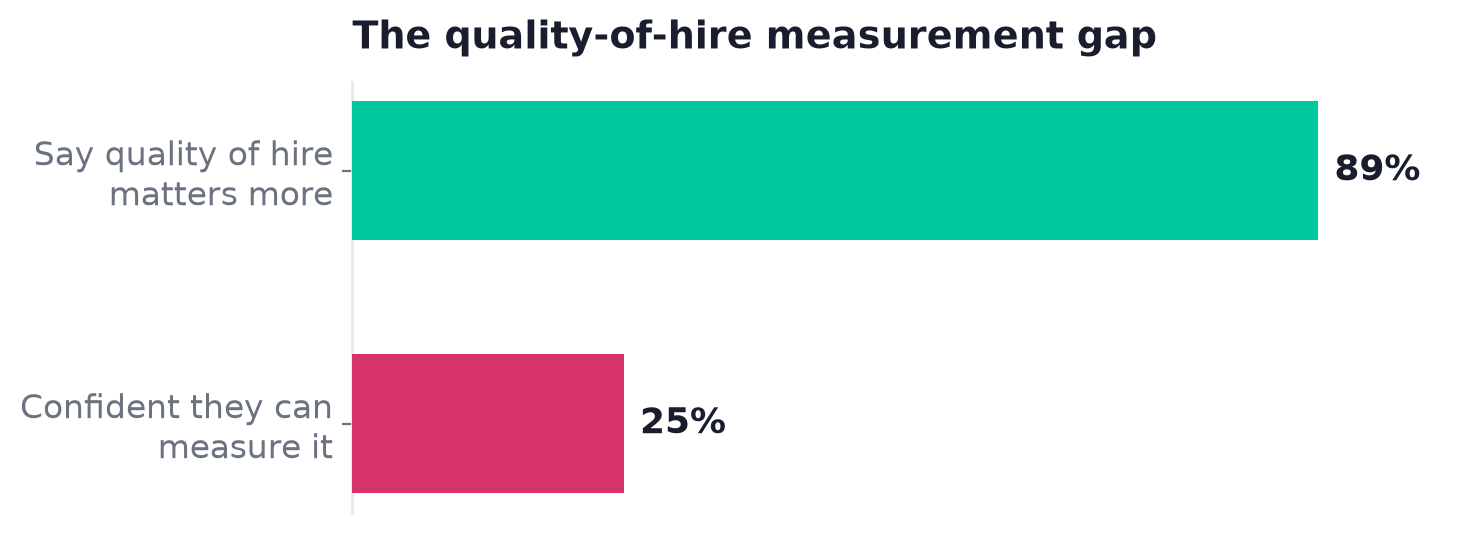
The quality problem is now acute. 89% of talent professionals say quality of hire is becoming more important, yet only 25% feel confident measuring it.15 Meanwhile, a study of ~19,000 interviews found up to 48% of candidates in technical roles show signs of unauthorized AI assistance in live coding — and 61% of those who cheated still passed.25 Legacy screening was built to filter volume; it cannot separate genuine capability from an AI copilot in the next window.
The cost of getting it wrong is not abstract. The U.S. Department of Labor's long-cited benchmark puts a bad hire at a minimum of 30% of first-year earnings; SHRM's replacement-cost range runs 50–200% of salary, skewing high for specialized roles.27 For a scarce engineer, a mis-hire is a double loss — the wasted spend and the vacancy that stays open.
06 — The Compliance LineIs AI sourcing legal if it doesn't scrape?
Scraping public data isn't a CFAA crime — but it still lost in court. Authorized, credential-based sourcing is the defensible path.
In hiQ Labs v. LinkedIn, the courts ultimately held that scraping public data is not a Computer Fraud and Abuse Act crime — yet hiQ still lost on trespass-to-chattels and misappropriation, faced a $500,000 judgment, and was enjoined from scraping LinkedIn.21 The lesson for agencies: "public" does not mean "safe." Bulk profile scraping also treats names, employment history, and contact data as personal data under GDPR and CCPA — exposure that exists independent of any platform's terms.24
This is why sourcing architecture matters. A model that works through authorized, bring-your-own-credential access to licensed channels — rather than scraping — keeps an agency's data practices defensible while still reaching the passive majority.
07 — The ThesisCan you win on speed and quality at the same time?
Yes — with AI on the repetitive work and human judgment on final selection, speed and quality now reinforce each other.
The old trade-off is dissolving. LinkedIn finds recruiters using AI-assisted messaging are +9% more likely to make a quality hire, and the most skills-based searches +12% more likely.15 Quality of hire is now the #1 stated TA priority at 55%.20 Among AI adopters, the technology returns roughly a full workday per week, which teams are redirecting into screening and skills assessment — not headcount cuts.15
The winning operating model is specific: let AI run continuous, compliant sourcing across every channel and score candidates against the requirement; let recruiters spend their recovered time on the human judgment that AI can't replicate. Fast and rigorous — because the speed comes from automation and the quality comes from focus.
"Speed is no longer the enemy of quality. Automate the search, and you free the recruiter to do the one thing that actually predicts a great hire: judgment."
08 — The PlaybookWhat should an IT staffing agency do about it?
Five moves separate the agencies that will win the next 24 months of technical hiring:
1. Source the passive 75%, not the active 25%. Build outreach around continuous, multi-channel sourcing — the best engineers won't come to a posting.
2. Compress time-to-submit. If top talent is gone in ten days, the first qualified submission usually wins. Automate everything before the human conversation.
3. Verify skill, not keywords. With AI in the interview room, screening has to test real capability — structured, defensible, and consistent.
4. Keep sourcing compliant. Authorized, credential-based access — not scraping — protects the agency as regulation tightens.
5. Measure quality of hire. Adopt the LinkedIn framework — performance ratings, retention, hiring-manager satisfaction — so you can prove outcomes, not just activity.15
This is precisely the model UPPER was built to run: autonomous, compliant, multi-channel sourcing that scores candidates against the requirement and starts outreach in one loop — so a lean technical-staffing team can move at the speed the market demands, and spend its human hours where they change outcomes.
Get the designed PDF edition
The full report, formatted as a shareable PDF for your team and clients. Enter your work email and we'll unlock the download.
★ Download the PDFSources
- BLS Occupational Outlook Handbook — Software Developers
- BLS Employment Projections 2024–2034
- BLS Occupational Projections & Characteristics
- CIO Dive / CompTIA — tech unemployment 2025
- CompTIA — State of the Tech Workforce 2025
- ISC2 — 2024 Cybersecurity Workforce Study
- SHRM — 2025 Benchmarking Reports
- Gem — 2026 Recruiting Benchmarks Report
- Ashby — Recruiter Productivity / Talent Trends
- LinkedIn — The Future of Recruiting 2025
- LinkedIn — Active vs. Passive Candidates
- PageUp — 2026 Talent Acquisition Priorities
- Morgan Lewis — LinkedIn v. hiQ analysis
- BBC — Clearview AI UK privacy fine
- Connecting People — AI cheating in technical interviews (Fabric/Karat/CoderPad data)
- Cost of a Bad Hire — DOL & SHRM citation trail
This report synthesizes third-party research current as of July 2026; figures are attributed to their original sources above. Some forward projections are inherently uncertain. UPPER edition H2 2026 — refreshed semiannually.