Key findings
01 — The DemandWhy is life sciences talent structurally scarce?
Because the qualified pool is small, specialized, and concentrated — not because demand is soft.
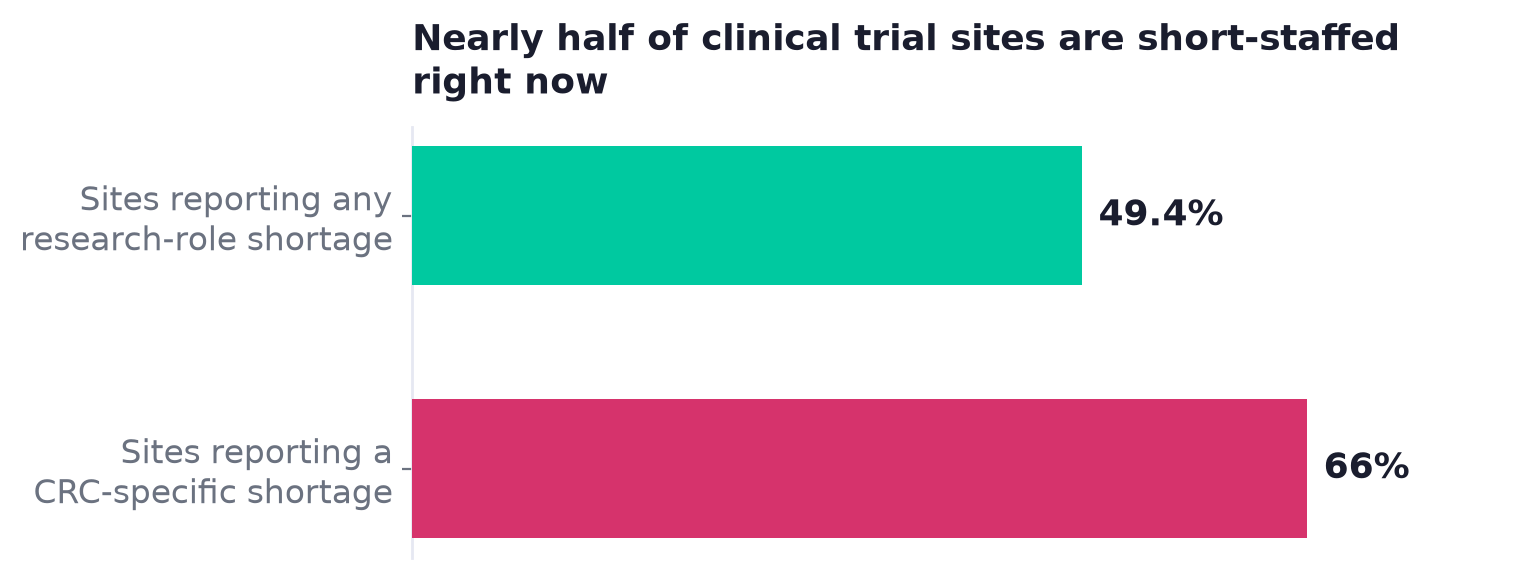
Life sciences hiring in 2026 runs against a pool that is small by design: candidates need domain-specific scientific training plus, in most clinical and regulatory roles, verifiable credentials that a general labor market doesn't require. Nearly half of clinical trial sites (49.4%) report at least mild staffing shortages across all research roles, and CRC-specific shortages run even higher at roughly 66%.2 This is not a temporary post-pandemic blip — it is the structural condition of the specialty.
02 — The ClockHow long do specialized life sciences roles really take to fill?
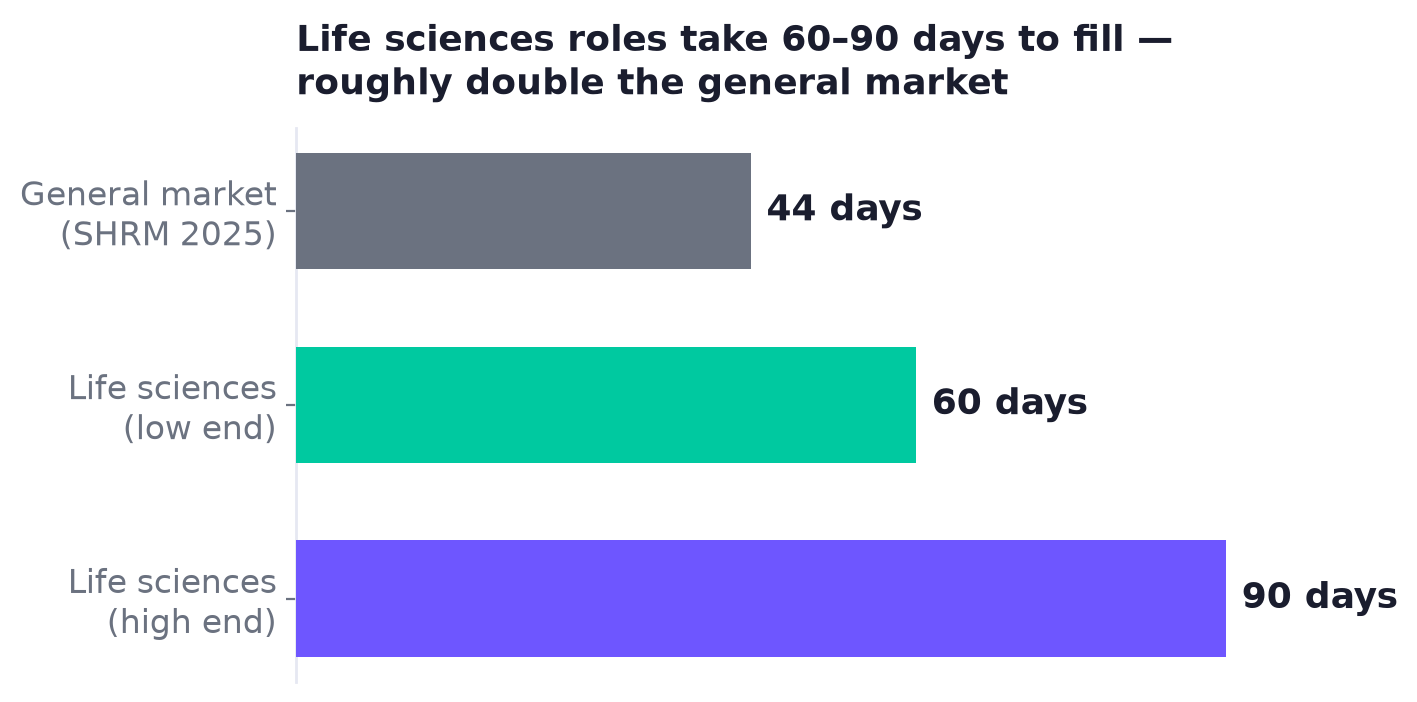
Roughly double the general market — and some director-level searches stretch far longer.
A specialized life sciences professional role takes 60–90 days to fill on average, versus 30–45 days generally.1 Some director-level or highly specialized roles stretch to 120–140 days.1 The gap compounds because credential and background verification alone can add four to six weeks to a regulated hiring timeline, since regulatory-board and training-record checks with prior employers take far longer than a university degree confirmation.5
03 — The Hub ProblemWhy does the same handful of employers keep competing for the same candidates?
Because life sciences talent is geographically concentrated in a way most industries aren't.
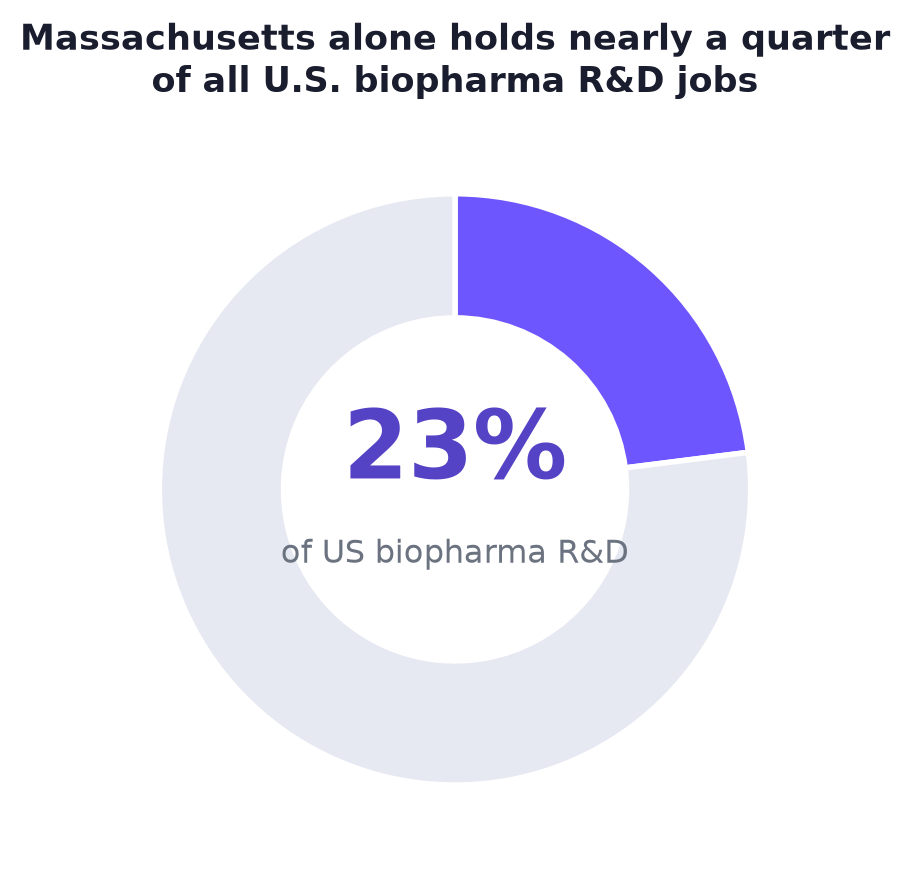
Massachusetts alone represents 23% of the entire U.S. biopharma R&D workforce, and the Boston-Cambridge cluster accounts for nearly 13% of all U.S. life sciences R&D roles.3 That means most qualified candidates already work for a direct or indirect competitor within commuting distance — sourcing that stays local is sourcing that recycles the same pool every search.
"Sourcing that stays inside the obvious hub is sourcing that recycles the same candidates every competitor already has on speed dial."
04 — The Retention CrisisWho is actually leaving, and why does it matter more than headcount alone?
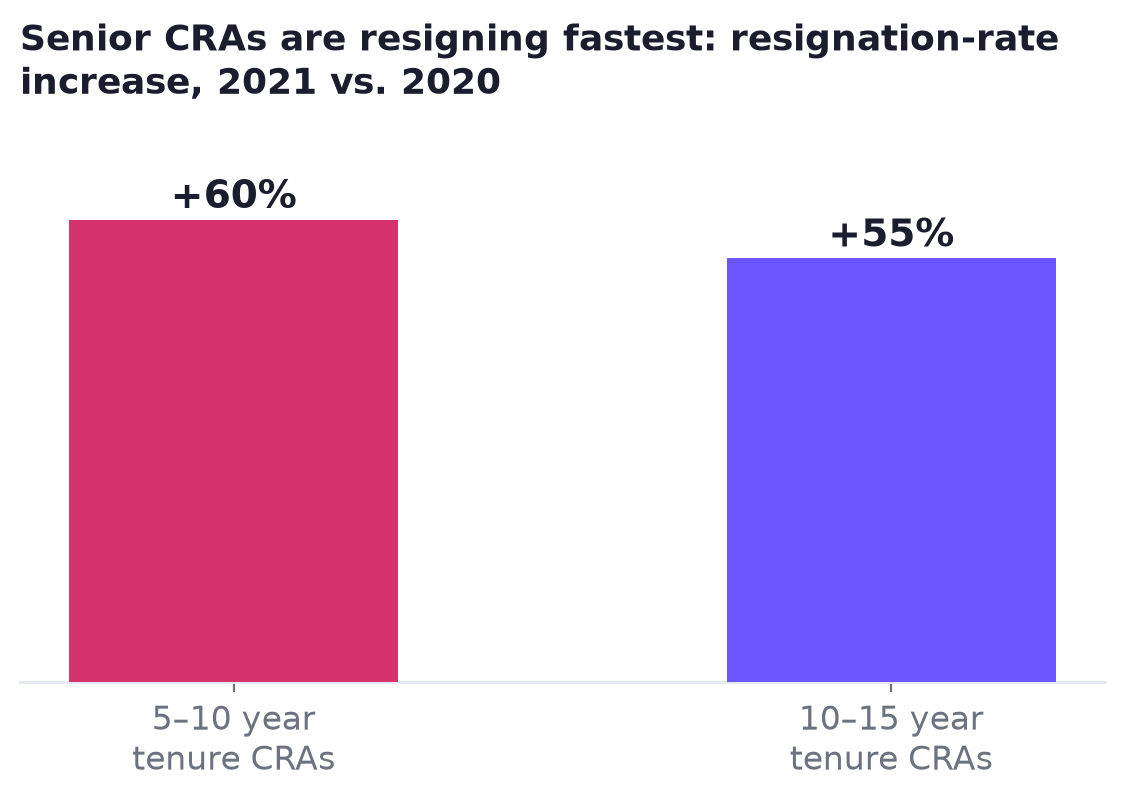
The most experienced clinical research talent is resigning fastest — and it's rarely visible on job boards.
Resignation rates among 5–10 year tenure CRAs rose 60% in 2021 versus 2020, with 10–15 year tenure CRAs close behind at roughly 55%.4 This experienced group is rarely active on job boards — they are employed, valued, and being courted quietly by competitors, which means passive-candidate sourcing is not optional in this market; it's the only way to reach the people who matter most.
05 — The Compliance LineCan verification run faster without cutting corners?
Yes — by running it in parallel with interviews instead of sequentially after an offer.
The default sequence in regulated hiring — screen, interview, offer, then verify — stacks four to six weeks of credential and licensure checks onto the back end of an already-long process.5 Running GxP training verification, RAC/CLIA credential checks, and reference calls in parallel with early-stage interviews reclaims that time without skipping any step a compliance-first hiring process requires.
06 — The PlaybookWhat should a life sciences staffing desk do about it?
Five moves separate the desks that will win the next 24 months of life sciences hiring:
1. Source against verified credentials, not resume keywords. GxP training, RAC, CLIA, and ASQ CQA status should gate sourcing, not just screening.
2. Run verification in parallel with interviews. Reclaim the 4–6 weeks regulated hiring typically loses to sequential background checks.
3. Reach beyond the obvious hub. With 23% of biopharma R&D concentrated in one state, deliberately source adjacent markets and diagnostics converts.
4. Target senior tenure directly. The most experienced CRAs are resigning fastest and are rarely active job-seekers — passive sourcing is required, not optional.
5. Pre-build compliance-verified benches for trial-critical roles. Enrollment windows don't wait for a 60–90 day search to conclude.
This is precisely the model UPPER was built to run: autonomous, credential-aware, multi-channel sourcing that verifies status in parallel with outreach — so a life sciences staffing desk can submit qualified, compliant candidates before an enrollment window closes.
Get the designed PDF edition
The full report, formatted as a shareable PDF for your team and clients. Enter your work email and we'll unlock the download.
★ Download the PDFSources
- GForce Life Sciences — Time to Hire Benchmarks in US Life Sciences Market
- Advarra — 2025 Workforce Development Survey Report
- MassBio — 2025 Industry Snapshot
- Society for Clinical Research Sites (SCRS) — Tackling the Great Resignation and Burnout in Clinical Research
- Element Staffing — Compliance-First Hiring Guide, 2026
- EPM Scientific — Boston Biotech Hub 2026
- Hyper Recruitment Solutions — 2025 Life Sciences Hiring Outlook
This report synthesizes third-party research current as of July 2026; figures are attributed to their original sources above. Some forward projections are inherently uncertain. UPPER edition H2 2026 — refreshed semiannually.