Key findings
01 — The DemandHow big is the manufacturing talent gap in 2026?
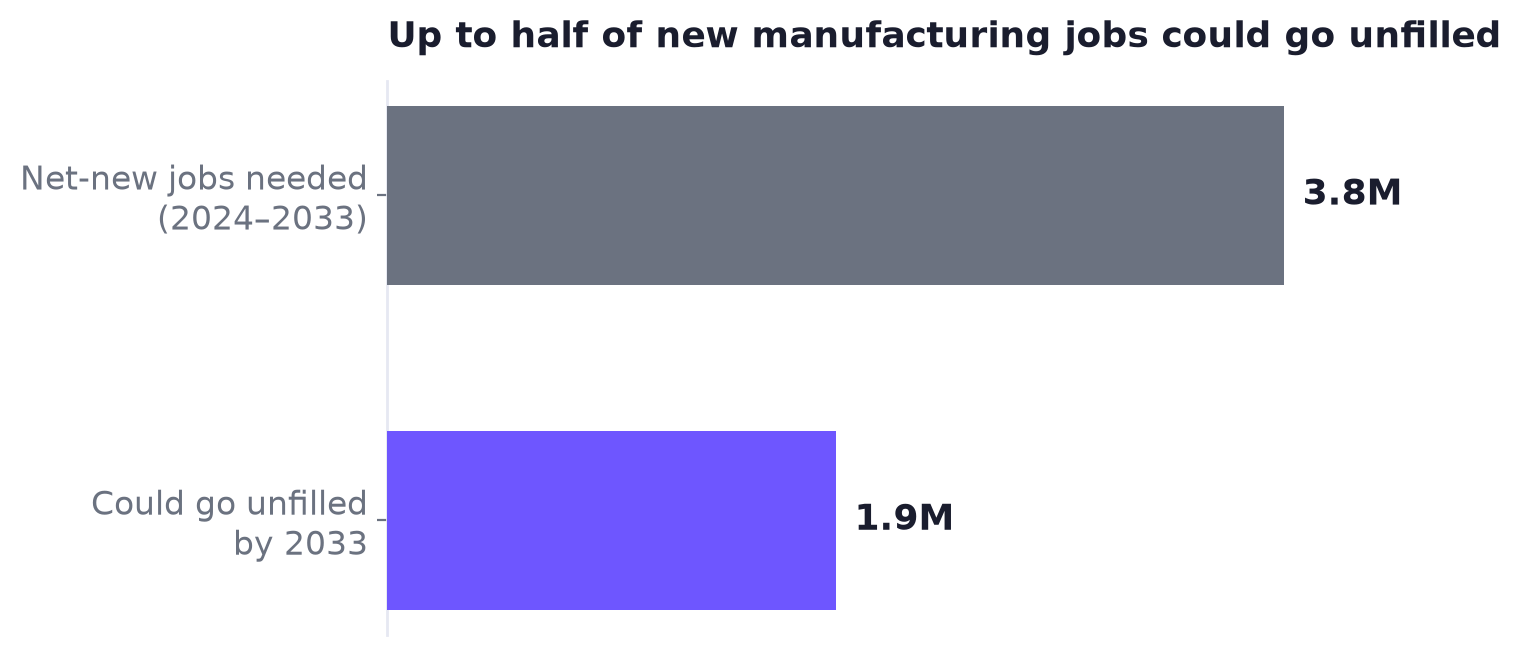
Up to half of the manufacturing jobs the U.S. needs to fill by 2033 could go unfilled.
The scale of the shortfall is no longer a forecasting footnote. Deloitte and the Manufacturing Institute estimate the U.S. will need 3.8 million new manufacturing workers between 2024 and 2033 — and that as many as 1.9 million of those roles could go unfilled if current skills and perception gaps persist.1 Left unaddressed, Deloitte projects the shortfall could cost the sector up to $1 trillion in unrealized economic output by 2030, and 77% of manufacturers already anticipate difficulty attracting talent.4
This is happening even as the sector expands. Manufacturing employment sat near 12.5–12.6 million jobs in mid-2026, with 439,000–495,000 monthly job openings reported by BLS JOLTS data — and reshoring and foreign direct investment added 244,000 newly announced jobs in 2024 alone, on top of 2 million cumulative since 2010.53 More capacity is coming online than the labor market can currently staff.
02 — The ClockWhy do skilled-trades roles take so much longer to fill?
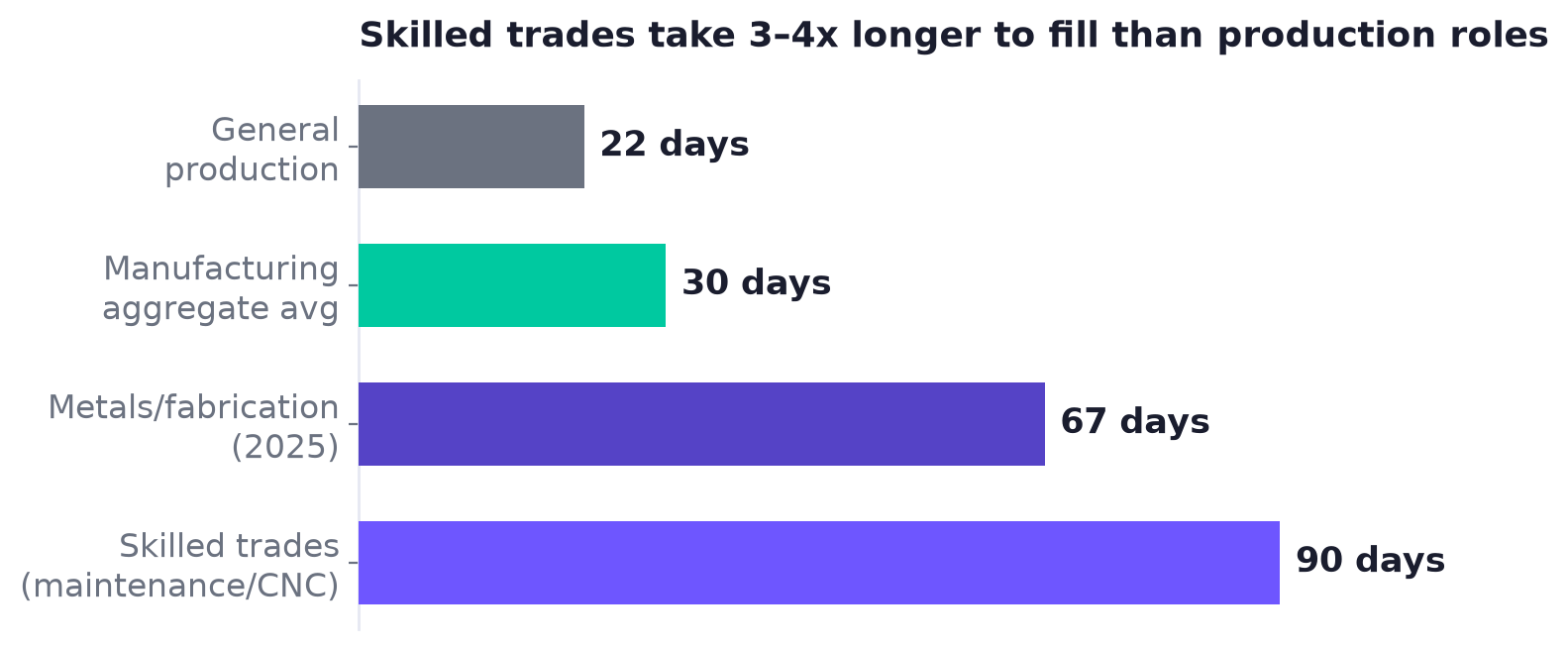
Skilled trades take 3–4x longer to fill than general production — and the gap is widening.
Not all manufacturing roles are equally hard to fill. General production and assembly roles fill in roughly 22–31 days on average, in line with — or faster than — the ~44-day SHRM cross-industry median.6 But skilled trades are a different market entirely: metals and fabrication roles averaged 67 days to fill in early 2025, up sharply from 42 days in 2019, and maintenance technician and CNC machinist searches routinely stretch past 90 days.7
The reason is structural, not cyclical: separations in manufacturing run at roughly 2.4–2.9% monthly (26–28% annualized), and 42% of machinist openings now originate from retirements rather than growth.67 Every skilled-trades req competes for a shrinking, aging pool.
03 — The Retirement WaveHow exposed is manufacturing to an aging workforce?
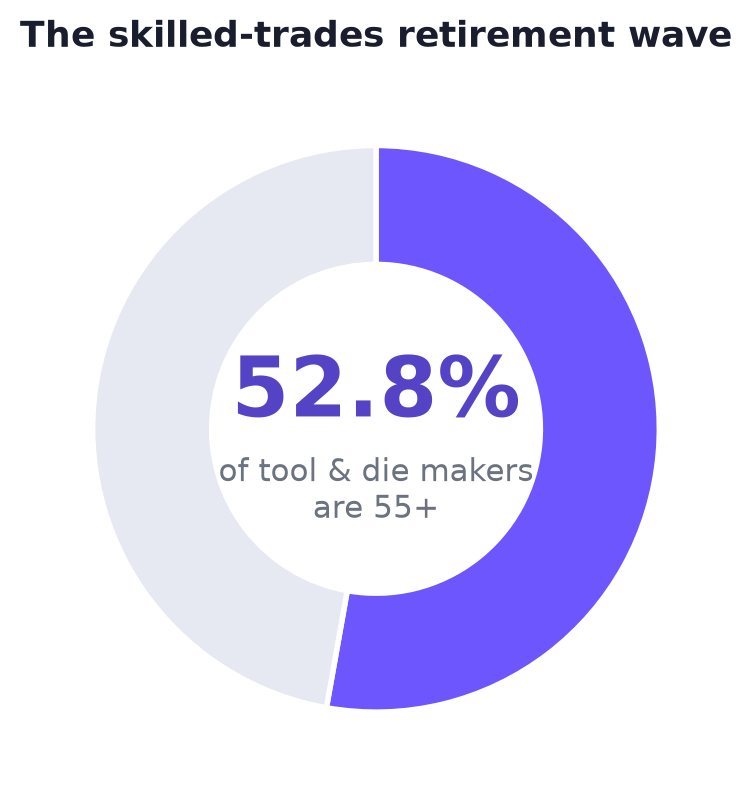
Over half of some skilled-trades occupations are already 55 or older — and the pipeline behind them is thin.
Roughly a quarter to a third of manufacturing workers are 55 or older, with the median manufacturing worker's age climbing from 40.5 in 2000 to 44.1 in 2018 — a faster rise than the broader workforce.29 In the most specialized trades the picture is starker still: 52.8% of tool-and-die makers are 55+, compared with only 13.9% aged 25–34.7 Welding faces its own cliff — the industry needs 320,500 new welders by 2029, while more than 157,000 current welders are near retirement age.8
"Roughly five skilled-trades workers retire for every two who enter the field. The shortage isn't coming — it's already here."
04 — The Attraction ProblemWhy won't Gen Z take these jobs?
Only 14% of Gen Z would consider industrial work — even though entry-level manufacturing pay beats the broader entry-level average.
The pipeline problem isn't only about retirements — it's also about who's willing to walk in the door. Gen Z's share of the manufacturing workforce actually declined from 8% to 7% since 2019, and 48% of Gen Z manufacturing workers say they intend to leave within 3–6 months, versus 41% in other sectors — most often citing a lack of career development as the reason.9 Only 14% of Gen Z say they'd consider industrial work at all.10
This is despite economics that should favor the sector: entry-level manufacturing pay averages roughly $60,000, well above the $36,000–$40,000 broader entry-level average.11 The barrier is perception and career-pathing, not compensation — which means sourcing has to actively counter outdated assumptions about the work, not just post the wage.
05 — The BottleneckWhat's actually stopping manufacturers from hiring faster?
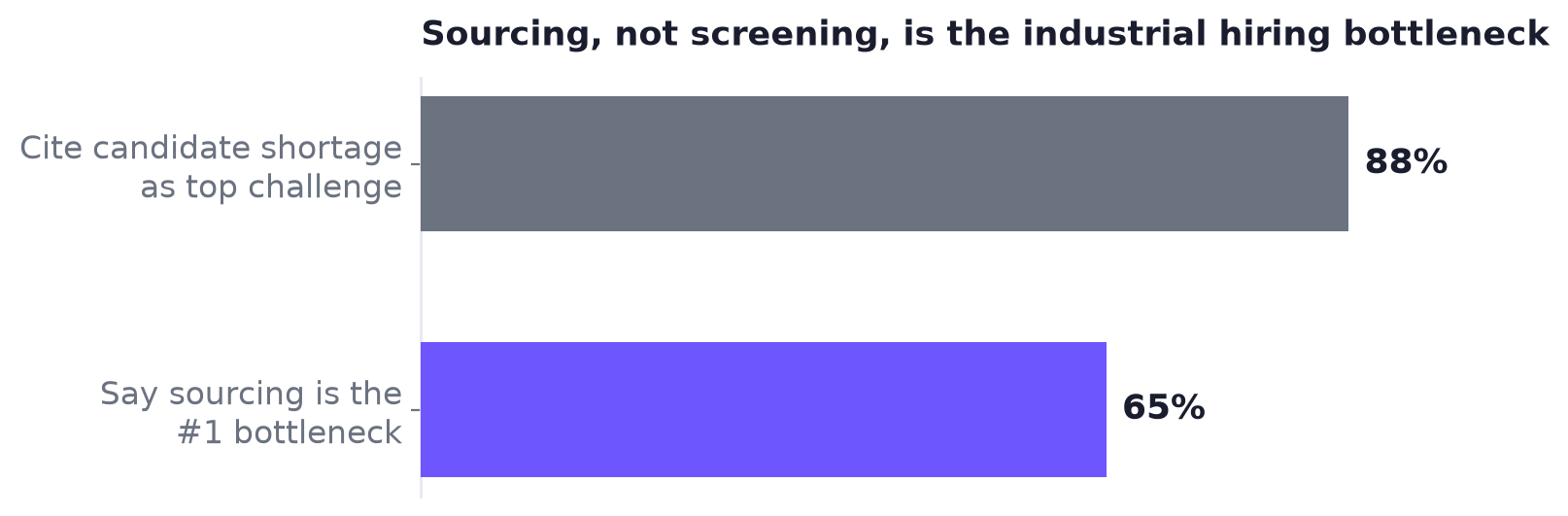
It's not screening capacity — it's finding qualified candidates in the first place.
88% of industrial hiring leaders cite a shortage of qualified candidates as their top challenge, and 65% say sourcing — not screening or interview scheduling — is their #1 bottleneck.7 Some plants are already feeling the operational effect: roughly 1 in 5 plants report failing to reach full capacity because of labor shortages, and shipbuilding alone faces a 200,000–250,000 worker shortfall with 27% of its workforce already 55+.12
Sourcing tools built for white-collar, LinkedIn-heavy candidate pools largely fail here: most machinists, welders, and maintenance techs don't maintain polished professional profiles, so keyword-based sourcing simply doesn't find them.
06 — The PlaybookWhat should a manufacturing talent team do about it?
Five moves separate the manufacturers and industrial staffing firms that will stay staffed through the retirement wave:
1. Source the passive skilled-trades workforce directly. Purpose-built blue-collar talent graphs reach machinists and welders that standard sourcing tools never see.
2. Map succession risk before the vacancy opens. With 42% of some openings driven by retirements, source replacements against a known retirement timeline, not a live req.
3. Verify certifications automatically. OSHA, CNC, welding, and forklift credentials should be validated before a recruiter ever opens a resume.
4. Widen the pipeline beyond keyword search. Skill-graph matching finds adjacent-trade talent that a title-only search misses.
5. Compress sourcing time, since that's the actual bottleneck. With 65% of leaders citing sourcing as the constraint, automating the top of funnel — not the paperwork — is where the time savings are.
This is precisely the model UPPER was built to run: autonomous, compliant, multi-channel sourcing that scores candidates against the requirement and verifies credentials in one loop — so a lean industrial talent team can keep the line staffed without waiting on a training pipeline that takes years to catch up.
Vendor-reported outcomes citing "5–10x faster mobilization" and "67% time-to-hire reduction" (Forbes, Skima AI, 2025) are directional industry claims from AI recruiting vendors, not independently audited benchmarks, and are presented here as context rather than guaranteed results.
Get the designed PDF edition
The full report, formatted as a shareable PDF for your team and clients. Enter your work email and we'll unlock the download.
★ Download the PDFSources
- National Association of Manufacturers / Deloitte — 2024 Manufacturing Talent Study
- A3 Association — The Great Knowledge Transfer
- Reshoring Initiative — 2025 Data Report
- Deloitte — Manufacturing Industry Diversity Insights
- U.S. Bureau of Labor Statistics — Manufacturing Industry (NAICS 31-33)
- First National Staffing — HR KPI Benchmarks: Time to Fill & Turnover
- 2026 State of Industrial Hiring Report
- A3 Association — Welder Retirement & Demand Data
- McKinsey — Getting and Keeping Gen Z in Manufacturing
- Fast Company — Gen Z and Factory Careers Survey
- Thomasnet / Parsable — Gen Z Manufacturing Perceptions Report
- OVI — Manufacturing Skilled Trades Hiring Crisis 2026
- Manufacturing Institute / Sloan — Aging in the Manufacturing Workforce
- HireAligned — Skilled Trades Hiring Statistics
- Forbes — How AI Is Solving America's $1 Trillion Manufacturing Labor Crisis
- LinkedIn Workforce Report — January 2026
This report synthesizes third-party research current as of July 2026; figures are attributed to their original sources above. Some forward projections are inherently uncertain. UPPER edition H2 2026 — refreshed semiannually.