Key findings
01 — The DemandWhy is recruiter capacity breaking down right now?
Because hiring volume and complexity are rising while TA headcount is falling — a structural mismatch, not a temporary spike.
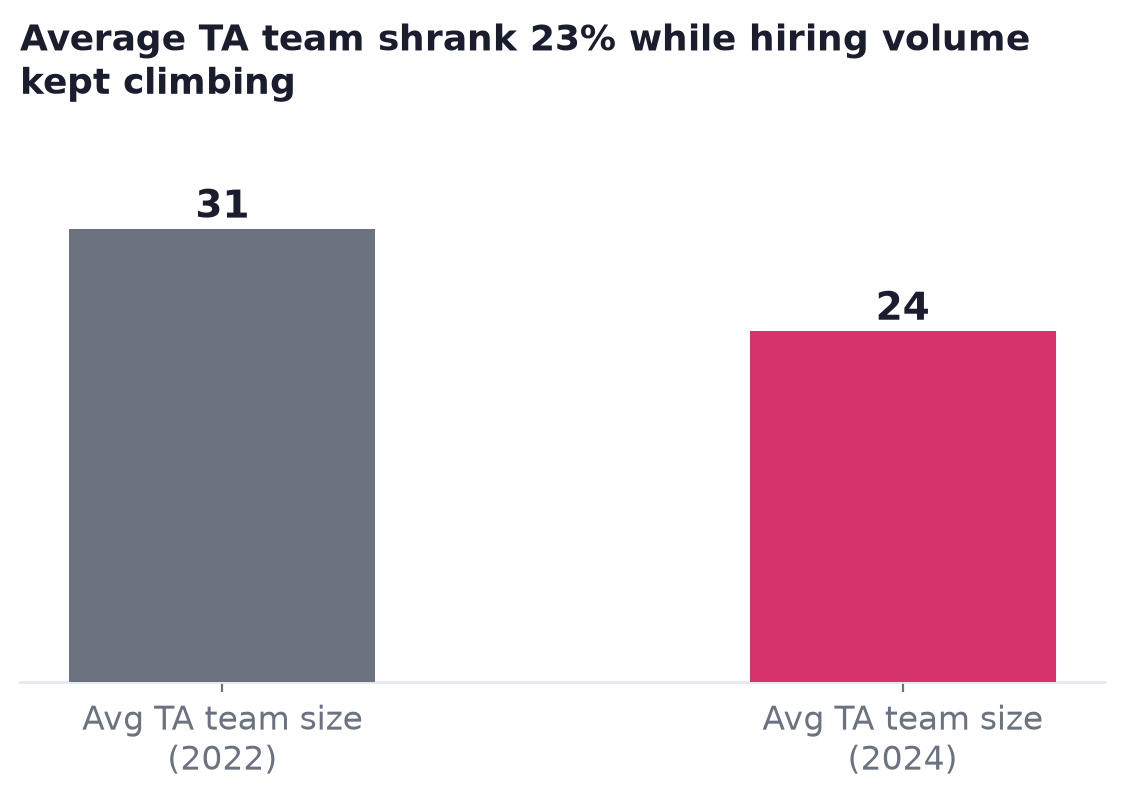
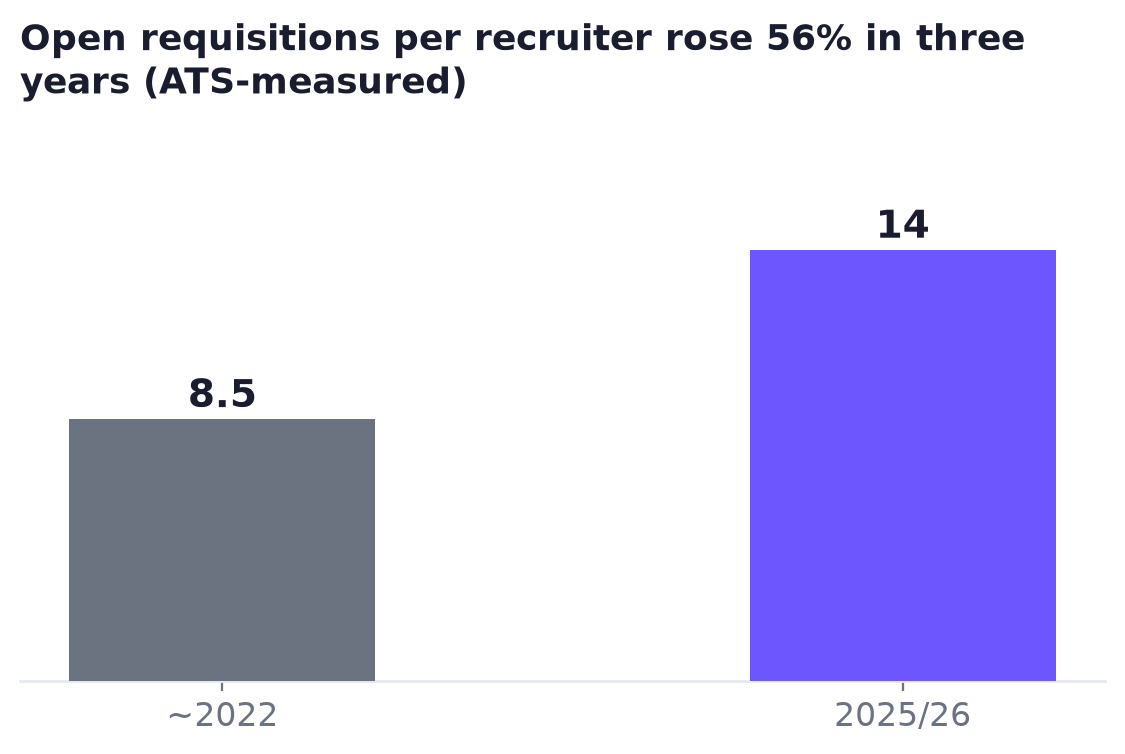
Corporate talent acquisition in 2026 is defined by a structural mismatch: hiring volume and complexity are rising while TA headcount is falling. The average recruiter now juggles 13.4–14 open requisitions at once — up 56% in three years — while the average TA team has shrunk from 31 people in 2022 to 24 in 2024, a 23% reduction in headcount during a period of rising hiring volume.1
74–76% of employers globally report difficulty finding the talent they need in 2024–2025 — near an 18-year high — even as overall hiring volume growth decelerates.5
02 — The ClockWhy is hiring getting slower even as AI adoption rises?
Because the bottleneck is systemic — recruiter bandwidth and process design — not just a missing tool.
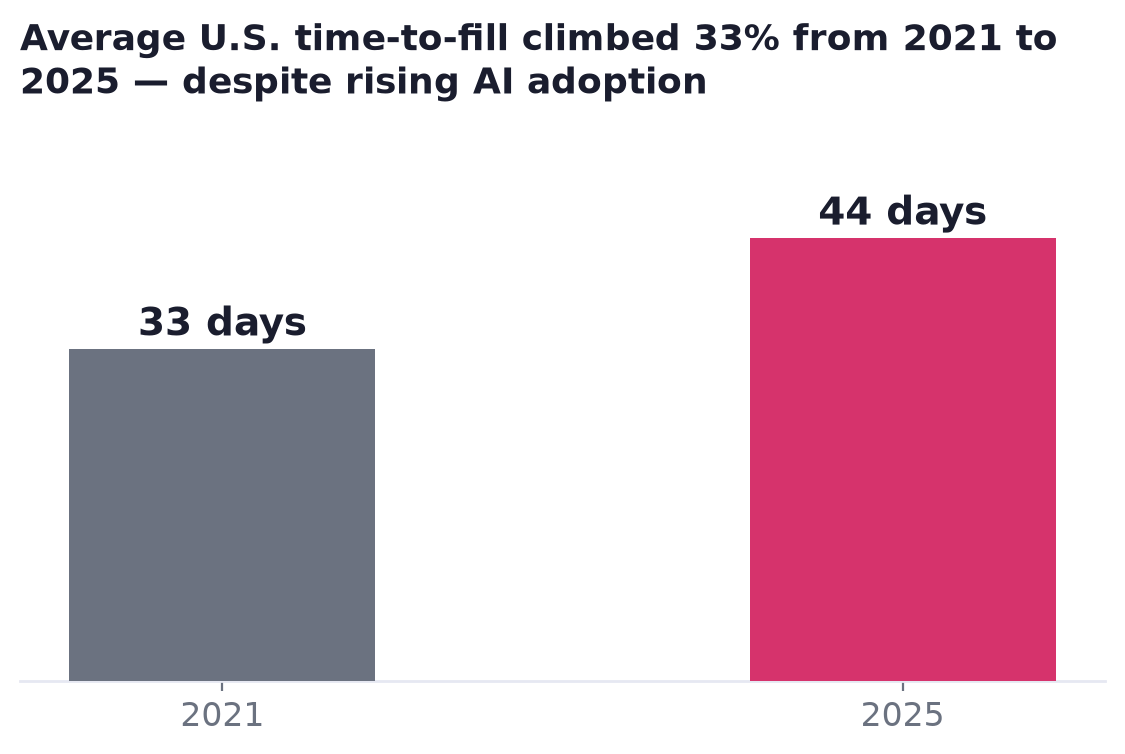
U.S. average time-to-fill has climbed to 44 days in 2025, up 33% from 33 days in 2021 — hiring is getting slower, not faster, even as AI adoption inside HR teams nearly doubled from 26% to 43% over the same period.2
Open reqs per recruiter climbed from roughly 8–9 to 13.4–14 over the same period — a 56% increase.6 Cost-per-hire and time-to-hire have both increased over the same three-year period that saw AI adoption inside HR surge — suggesting point-solution AI adoption alone hasn't solved the capacity problem.7
03 — The CostWhat does the capacity squeeze actually cost?
SHRM's benchmarking puts a hard number on it — and executive hiring carries a very different price tag.
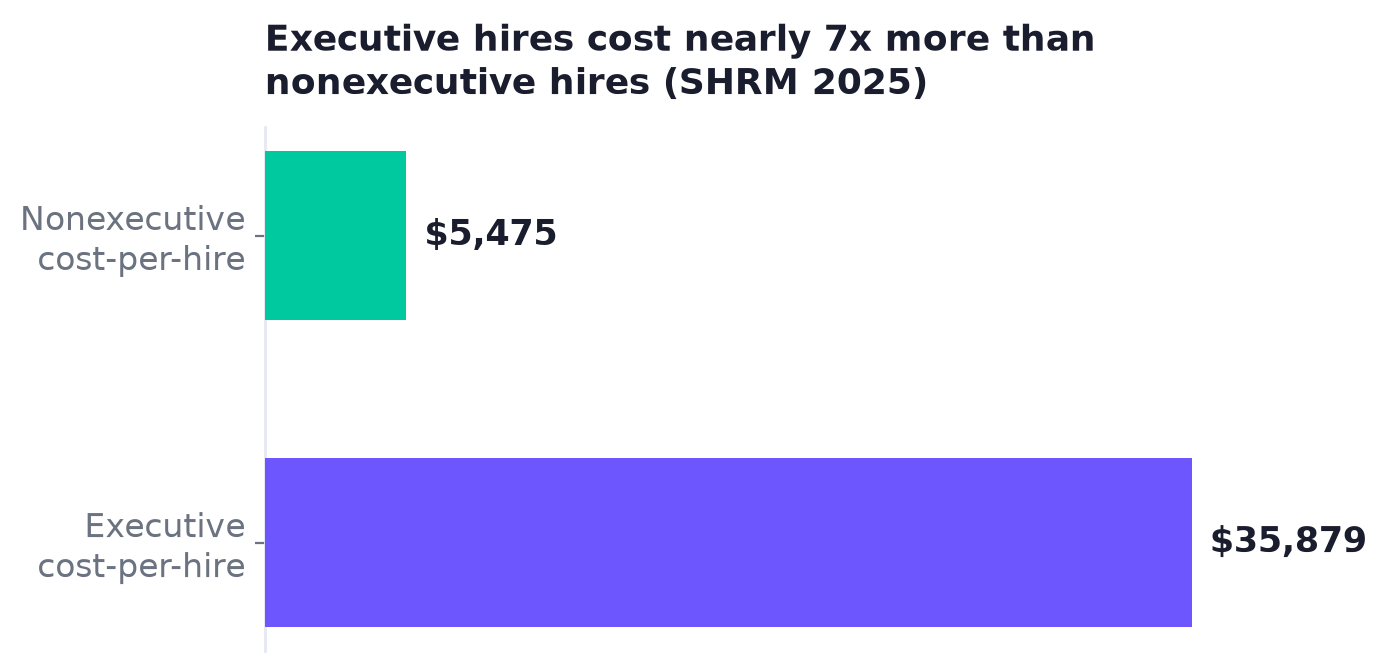
SHRM's 2025 Benchmarking Report puts average cost-per-hire at $5,475 for nonexecutive roles and $35,879 for executive roles — executives now cost nearly 7x more to hire than nonexecutive staff.3
"Recruiter-to-requisition ratios have blown through every prior 'healthy' benchmark — the trajectory, not just the level, is the warning sign."
04 — The Governance GapWhy is quality of hire still an afterthought?
Because most TA functions are optimizing for speed and volume without a systematic quality feedback loop.
Only about 20% of organizations currently track quality-of-hire as a metric at all, meaning most TA functions and their RPO partners are optimizing for speed and volume without a systematic quality feedback loop — a governance gap that autonomous, data-native sourcing can help close by design.4 Candidates sourced proactively by recruiters are reported to be 8x more likely to be hired than inbound job-board applicants, reinforcing that the scarce resource in TA isn't application volume — it's qualified, engaged, sourced candidates.8
05 — The ResetHow does AI actually change the capacity math?
By absorbing the top of the funnel first — sourcing and initial screening — where it delivers the largest throughput gains.
AI-augmented recruiters can review 40–80 candidate screens per day versus 6–10 manual phone screens — a 5–8x throughput increase that directly addresses the 56% req-load increase teams have absorbed without proportional headcount growth.9 Time from first contact to offer acceptance averages 28 days with AI-assisted sourcing versus 41 days with manual sourcing — a 13-day compression directly against the ballooning 44-day time-to-fill baseline.10 Companies using AI sourcing tools report 35–45% lower cost-per-hire compared to those relying exclusively on job boards and agency relationships.10
With AI handling high-volume initial evaluation, sustainable requisition load per recruiter can rise from an unaided 15–25 reqs to 25–40 reqs without the quality degradation seen beyond the 20–30 threshold — effectively resetting the capacity ceiling that today's leaner teams are slamming into.9
06 — The PlaybookWhat should RPO providers and in-house TA leaders do about it?
Five moves separate the teams that will win the next 24 months of corporate talent acquisition:
1. Benchmark against ATS-measured reality, not aspirational ratios. Plan capacity around the 13–14 req/recruiter reality, and treat the 20–30 req band as a hard ceiling before quality degrades.
2. Automate the top of the funnel first. Sourcing and initial screening consume the most recruiter hours and are where AI delivers the largest throughput gains.
3. Make quality-of-hire a tracked, closed-loop metric. With only 20% of organizations currently tracking it, this is a genuine differentiator.
4. Shift recruiter time from admin to coordination and closing. Redeploy reclaimed time to hiring-manager alignment and candidate experience.
5. Sell capacity elasticity, not headcount replacement. Position autonomous AI sourcing as a way to absorb rising req loads without permanently expanding fixed TA headcount.1
This is precisely the model UPPER was built to run: autonomous sourcing, scoring, and outreach as one connected loop — so a leaner TA team or RPO provider can absorb rising requisition load without adding headcount, and prove quality of hire instead of just activity.
Get the designed PDF edition
The full report, formatted as a shareable PDF for your team and clients. Enter your work email and we'll unlock the download.
★ Download the PDFSources
- Pin — Recruiting Team Structure (Gem 2026 Benchmarks synthesis)
- SHRM — 2025 Recruiting Benchmarking Report
- InterviewCost.com — SHRM Average Cost Per Hire 2025
- Pin — High-Volume Hiring with AI: The Complete Playbook
- SocialTalent — The 2025 Hiring Reality Check (ManpowerGroup data)
- Pin — Recruiter Capacity Benchmarks 2026
- Intervuebox — Staffing Firm AI Hiring: The Gap Costing Talent Teams
- HiredAi — Recruiter Outreach Stats 2026
- Outhire — Recruiter Productivity Benchmarks 2026
- Noon AI — Recruitment Statistics 2026 (Aptitude Research data)
This report synthesizes third-party research current as of July 2026; figures are attributed to their original sources above. Some forward projections are inherently uncertain. UPPER edition H2 2026 — refreshed semiannually.