Key findings
01 — The CollapseWhy has quota attainment fallen so far?
Less than half the reps who hit quota in 2018 do today — this is structural, not cyclical.
Salesforce's State of Sales research (6th edition) found that only 27% of sales reps hit quota in 2023, down sharply from 53% in 2018 — a collapse of nearly half in five years.1 The drivers are structural: buying committees have grown larger and more cross-functional, self-serve research means buyers engage sellers later in the cycle, and deal complexity has risen even as budgets tightened.
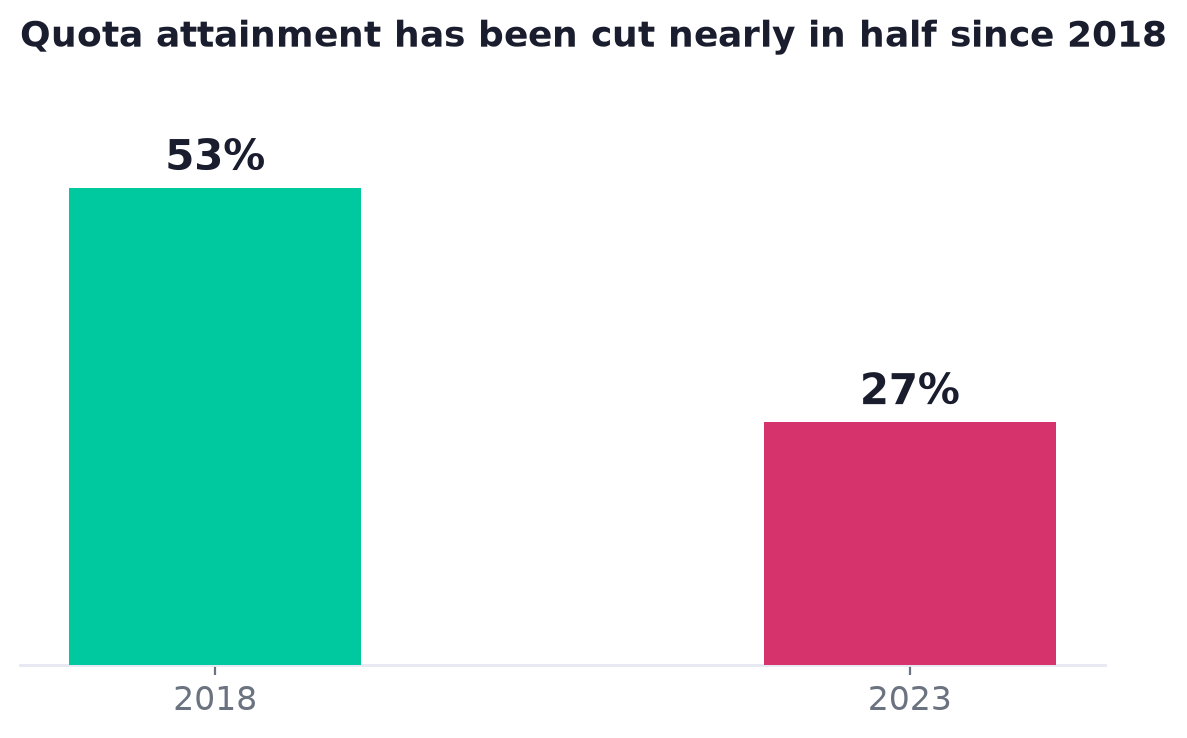
This isn't a hiring-volume problem — it's a hiring-quality problem. When barely a quarter of reps hit number, the cost of misjudging who will perform compounds across every open seat on the team.
02 — The ChurnWhy does sales turnover run so much higher than everywhere else?
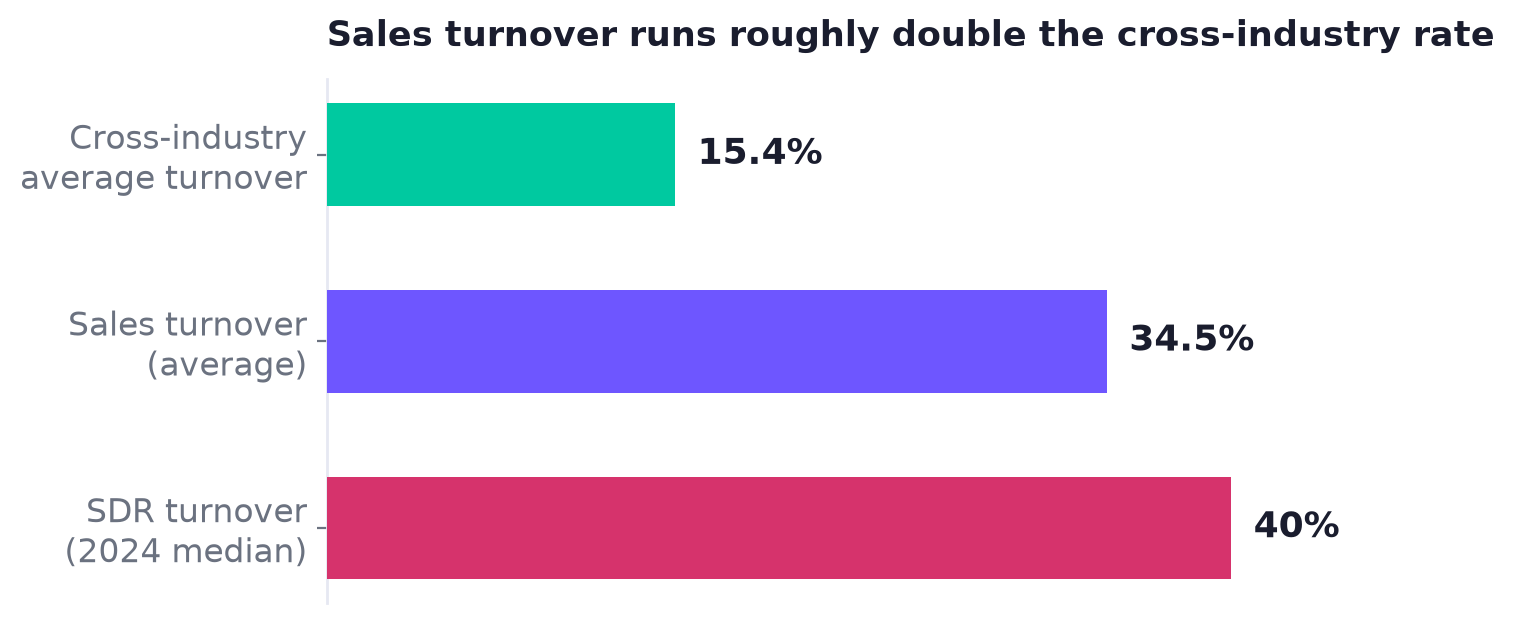
Sales turnover runs roughly double the cross-industry average — and SDR turnover is even worse.
Sales turnover averages 34% to 35%, compared with a 13% to 17.8% average across all industries — meaning a sales organization can expect to lose roughly a third of its team every year just from baseline attrition.2 The Bridge Group's 2025 SDR Metrics & Compensation Report found SDR turnover hit a 40% median in 2024, with average SDR tenure sitting at just 1.9 years.6
There's a silver lining in the same data: SDR ramp time has actually improved to 3.0 months, the fastest on record and down from 3.8 months in 2014 — showing that when onboarding and enablement are done well, new reps can reach productivity faster even in a high-churn environment.6
03 — The CostWhat does a bad sales hire actually cost?
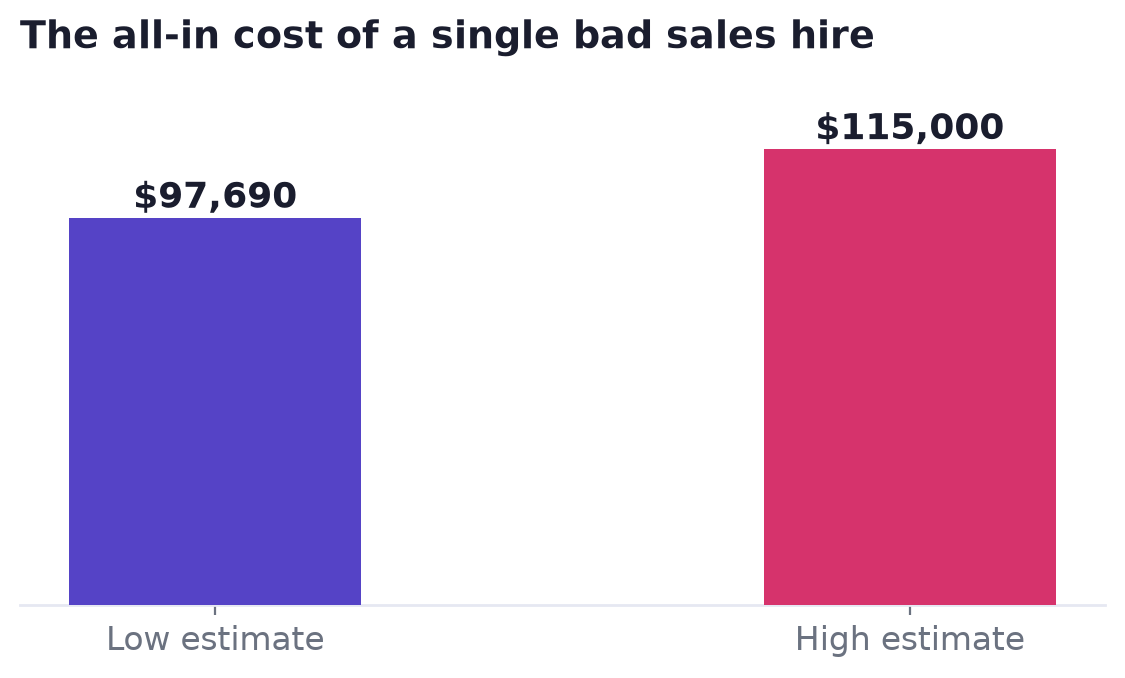
Close to six figures per mis-hire — and that's before counting the pipeline it never generated.
Research from DePaul University, cited via CACI, puts the true cost of replacing a sales rep at $97,690 to $115,000 once recruiting costs, ramp time, management time, and lost sales opportunity are all counted.3 With SDR turnover at 40% and sales turnover at 34-35%, that cost compounds fast across a growing revenue team.
Gartner data (via Business Wire) shows the supply side is just as tight: roughly three candidates compete for each open B2B sales role on average, and open sales positions stay unfilled for about two months — meaning revenue leaders can't just "hire more carefully" from an abundant pool; the market itself is thin.5
04 — The AI EdgeDoes AI actually move the performance needle for sellers?
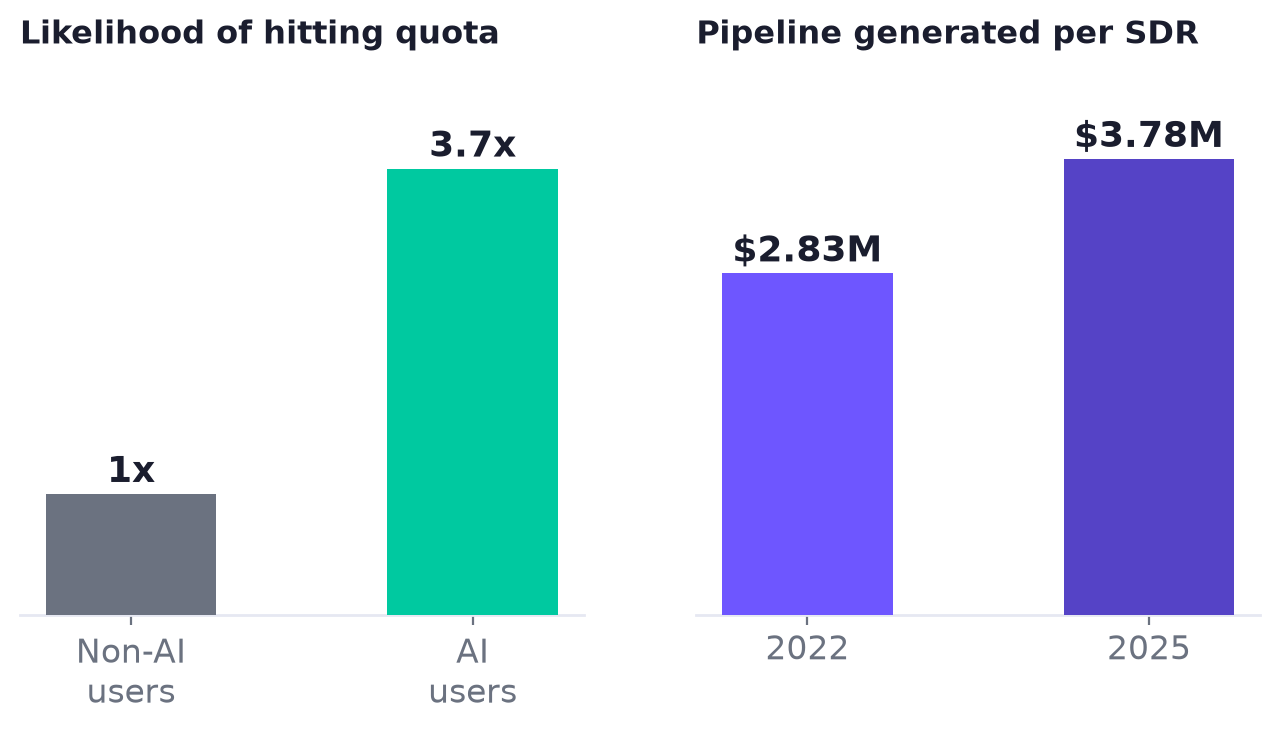
Yes — sellers using AI meaningfully outperform those who don't, and the productivity data backs it up.
Salesforce's 2026 State of Sales data found that reps who use AI are 3.7x more likely to hit quota than non-users, and 88% of sellers using AI agents report the technology helps them sell more effectively.4 Pipeline generation per SDR has grown substantially in parallel — from $2.83M in 2022 to $3.78M in 2025 — even as team sizes and ramp times shifted.6
"Only 27% of reps hit quota in 2023 — down from 53% in 2018. The market isn't short on sellers. It's short on sellers who actually perform."
The gap isn't closing on its own, though: Gartner projects (via a Sales & Marketing Management focus report) that 58% of sellers will need reskilling for AI-augmented selling by 2026 — meaning adoption and its benefits remain uneven across teams, and the advantage still belongs to organizations that move early.7
05 — The PlaybookWhat should a revenue leader do about it?
Five moves separate the GTM organizations that will build a high-performing bench over the next 24 months:
1. Source for performance signal, not résumé polish. With only 27% of reps hitting quota, interview performance alone is a weak predictor — score candidates on quota-attainment history and ramp speed instead.
2. Build a warm bench before the next departure. At 34-35% sales turnover and 40% SDR turnover, always-on sourcing beats reactive, post-departure scrambling every time.
3. Price in the true cost of a mis-hire. At $97,690+ per bad hire, spending more time and rigor upfront pays back immediately.
4. Reach passive GTM talent directly. With only ~3 candidates competing per open role, a posting-only strategy leaves most of the addressable market untouched.
5. Adopt AI-augmented selling and sourcing together. AI users are 3.7x more likely to hit quota — pairing AI-native sourcing with AI-enabled sellers compounds the advantage.4
This is precisely the model UPPER was built to run: continuous, performance-signal-aware sourcing across AEs, SDRs, and GTM leaders — so revenue leaders build pipeline of candidates who are statistically more likely to perform, not just interview well.
Get the designed PDF edition
The full report, formatted as a shareable PDF for your team and clients. Enter your work email and we'll unlock the download.
★ Download the PDFSources
- Salesforce, "State of Sales," 6th Edition (PDF)
- Bridge Group, "2025 SDR Models & Metrics Report"
- CACI, "The True Business Cost of Replacing a Rep" (citing DePaul University research)
- Salesforce, "State of Sales Statistics" 2026
- Gartner via Business Wire, sales hiring market data
- Bridge Group, "2025 SDR Models & Metrics Report" (SDR turnover, tenure, ramp time, pipeline data)
- Sales & Marketing Management, Focus Report, July 2025 (PDF, citing Gartner)
This report synthesizes third-party research current as of July 2026; figures are attributed to their original sources above. Market-size figures across research vendors diverge by methodology — directional trends are emphasized over precise absolute figures. UPPER edition H2 2026 — refreshed semiannually.