Key findings
01 — The GapHow big is telecom's workforce shortfall?
The U.S. broadband build-out faces a combined 178,000-worker gap over the next decade.
A Pew-published analysis by Continuum Capital for the Fiber Broadband Association and PCCA estimates the U.S. will need 58,000 new broadband construction and technician workers — 28,000 in construction and 30,000 in technician roles — plus another 120,000 replacement workers (56,000 construction, 64,000 technician) over the next decade.1 That's a combined gap of roughly 178,000 workers against a backdrop of a $42.5 billion federal BEAD program, where 41 states plus D.C. have already flagged workforce availability as a deployment risk.1
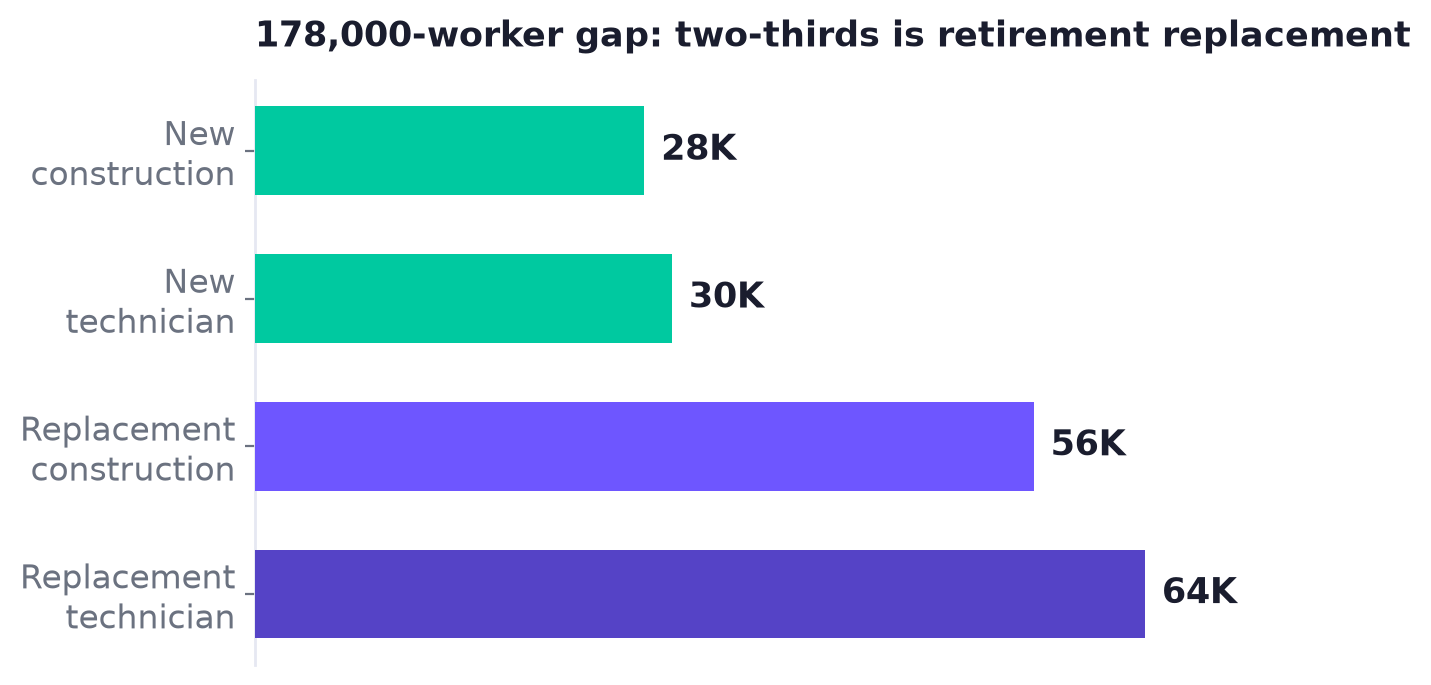
The timeline pressure compounds the shortage: training a qualified technician takes 12–24 months, while BEAD's deployment window runs just 2025–2032, and Capital Projects Fund (CPF) dollars must be expended by the end of 2026.1 There isn't enough runway to train the entire gap away — employers have to source experienced and transferable-skill talent now.
02 — The Aging WorkforceWhy is telecom's talent pool shrinking from the top down?
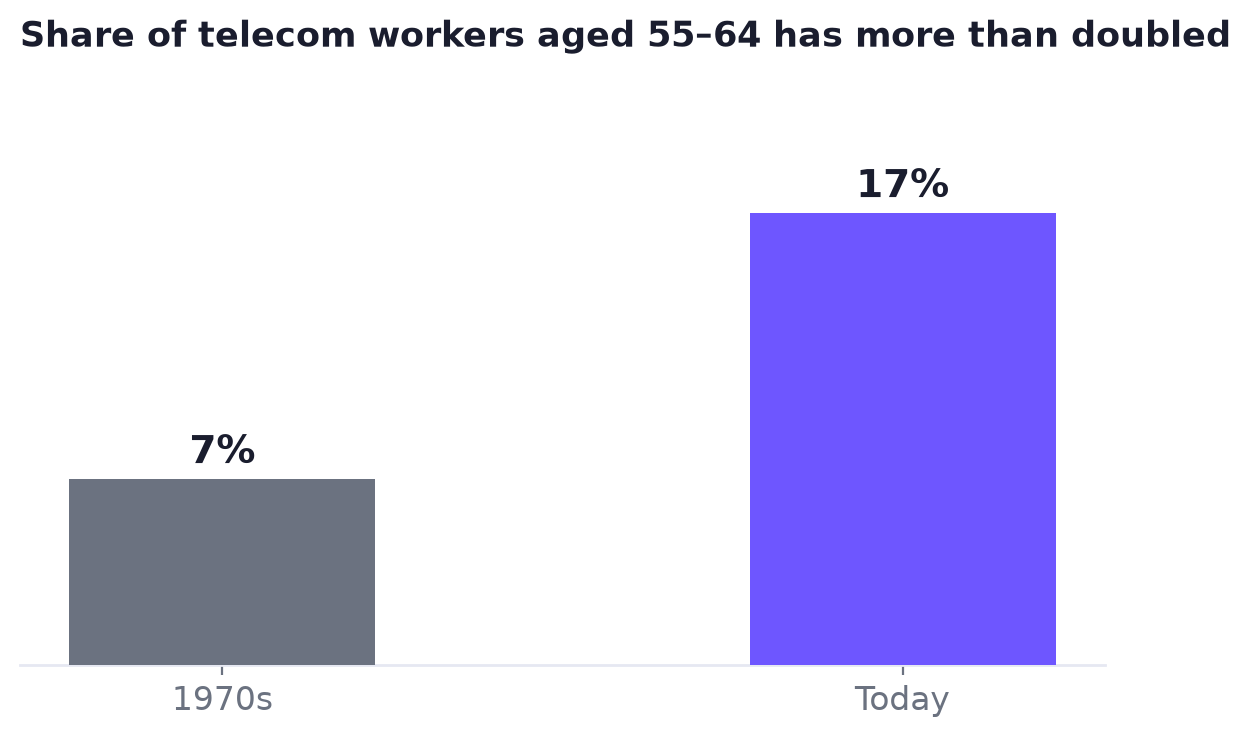
The share of telecom workers 55-64 has more than doubled since the 1970s.
17% of telecom workers today are 55–64, compared with just 7% in the 1970s, and the share of workers 65 and older has tripled.1 A 2022 GAO estimate put the fixed-broadband workforce at 477,700 and mobile-broadband workers at 88,600 — a base that's aging faster than it's being replenished.1 Roughly two-thirds of the decade's total worker need — 120,000 of the 178,000-worker gap — is retirement replacement rather than growth.1
Compounding the pipeline problem, union representation in telecom fell from 26% in 2000 to 11% in 2024 — eroding the apprenticeship structures that historically fed new workers into the trade.1
03 — The Build-OutHow much infrastructure does this workforce actually need to staff?
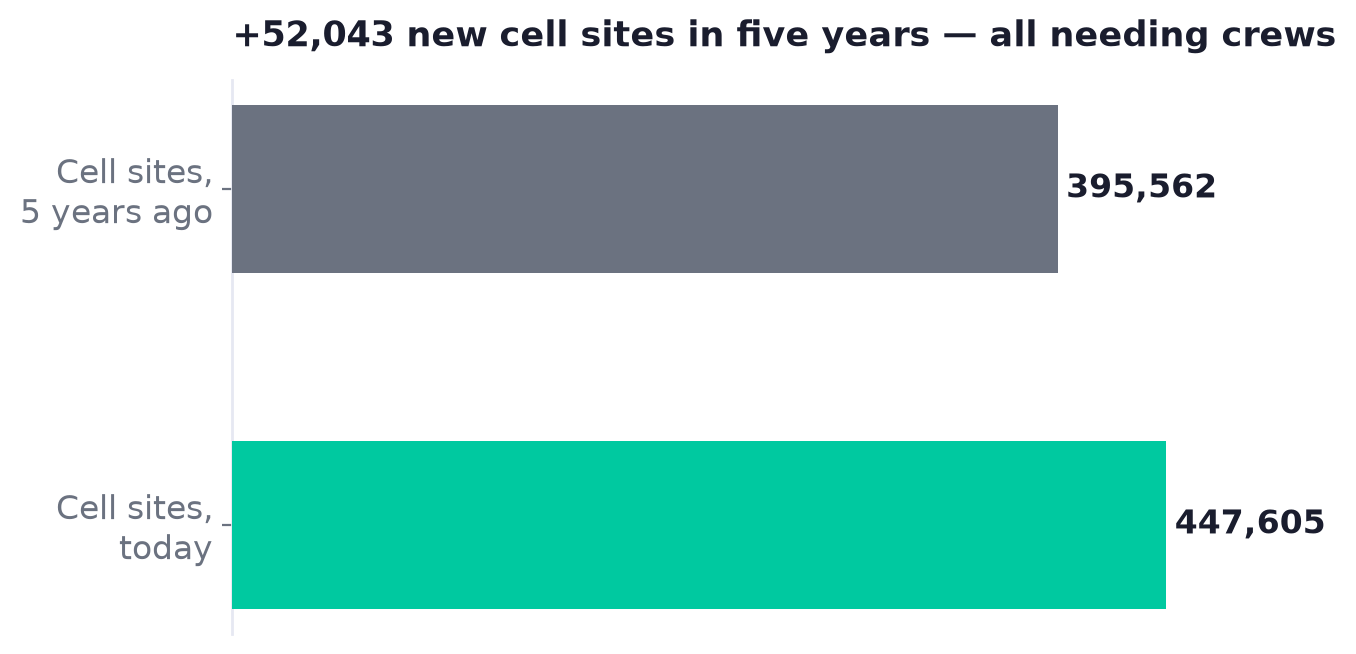
U.S. wireless carriers have built out $734B+ in cumulative infrastructure — and it all needs crews to install, maintain, and expand it.
U.S. wireless carriers have invested more than $734 billion cumulatively, including $30 billion in 2024 alone, building out to 447,605 operational cell sites — an increase of 52,043 sites in just five years.2 BLS counts roughly 91,770 telecom equipment installers/repairers, 60,030 line installers/repairers, and 13,950 electronics engineers within the telecom NAICS classification — a workforce that has to grow in step with the infrastructure buildout.3
Line installer median wage sits at $64,640/year, with equipment installers earning roughly $33.79/hour and line installers $39.45/hour — solid wages that still haven't grown meaningfully faster than the broader economy for the top five broadband occupations between 2010 and 2021.61
04 — The Credentialing GapWhy is it so hard to verify telecom candidates?
There's still no uniform credentialing standard for telecom job titles — making candidate comparison difficult.
A gap identified by GAO in 2020 remains unresolved as of 2025: there is no uniform credentialing standard across the industry for broadband and telecom job titles, meaning candidates trained at different programs or on-the-job pathways are difficult to compare on paper.1 Roughly 10–15% of telecom workers already travel 200+ miles for rural fiber and tower work, adding a geographic-matching problem on top of the credentialing one.1
"Telecom doesn't have a talent-pool problem so much as a talent-visibility problem — the workers exist, but there's no common language to find and compare them."
05 — The PlaybookWhat should a telecom talent team do about it?
Five moves separate the telecom employers that will staff the BEAD-era build-out on schedule:
1. Normalize certifications into one taxonomy. AI-assisted sourcing can parse and standardize fragmented credentials across different training backgrounds.
2. Source geography-aware, not just keyword-aware. Map candidate location and travel willingness against project sites to close the mismatch between talent and BEAD-funded work.
3. Build succession benches ahead of retirements. With two-thirds of the gap being replacement, not growth, source successors before the vacancy opens.
4. Widen the aperture to adjacent trades. Electricians, cable installers, and military communications veterans bring transferable skills that traditional sourcing overlooks.
5. Move faster than the training pipeline. With training taking 12-24 months against multi-year federal deadlines, sourcing experienced talent now closes gaps a training pipeline can't close in time.
This is precisely the model UPPER was built to run: autonomous, compliant, multi-channel sourcing that normalizes credentials and reaches geographically dispersed field talent in one loop — so telecom employers can staff build-out deadlines that don't move.
Get the designed PDF edition
The full report, formatted as a shareable PDF for your team and clients. Enter your work email and we'll unlock the download.
★ Download the PDFSources
- Pew Charitable Trusts — Demand for Broadband Workforce Expected to Rise, October 2025
- CTIA — 2025 Annual Wireless Industry Survey
- U.S. Bureau of Labor Statistics — Telecommunications Industry (NAICS 517)
- CTIA — Cumulative Wireless Carrier Investment Data, 2025
- Redline Group — RF/Microwave Skills Gap (UK context)
- Cabling Installation & Maintenance (citing BLS) — Telecom Technician Pay Data
This report synthesizes third-party research current as of July 2026; figures are attributed to their original sources above. The UK RF/microwave skills-gap reference is included as an illustrative international parallel, not a direct U.S. statistic. Some forward projections are inherently uncertain. UPPER edition H2 2026 — refreshed semiannually.