Key findings
01 — The ContractionIs media and entertainment shrinking or restructuring?
Both — headcount is falling even as specific skill categories, like advertising, are projected to grow.
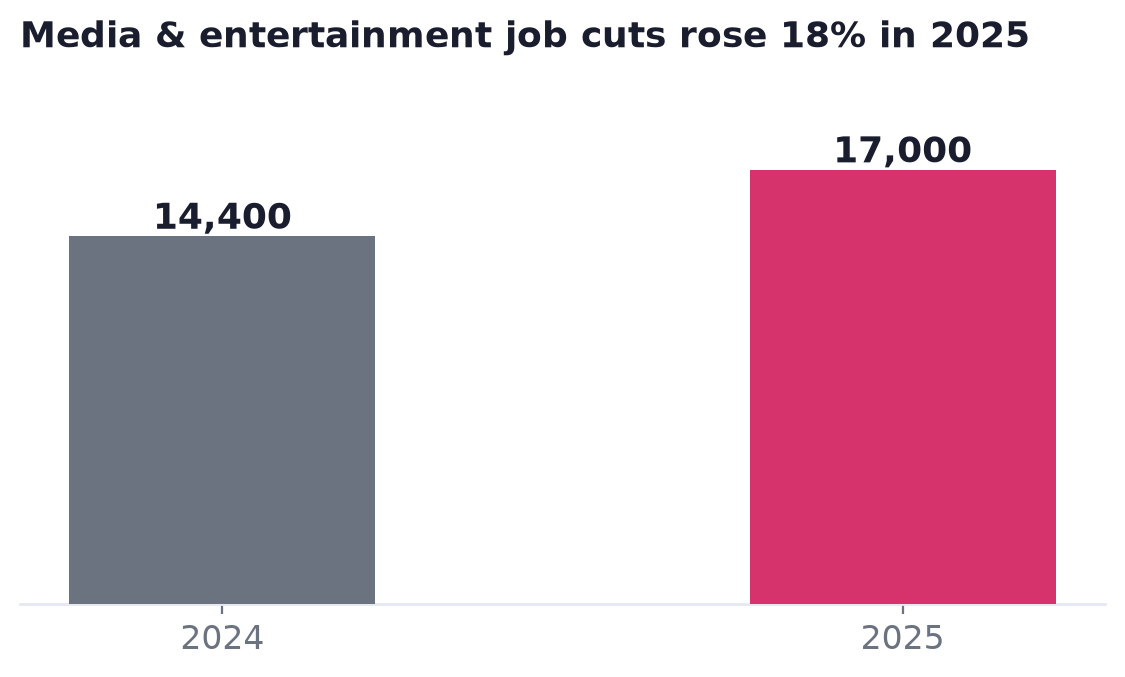
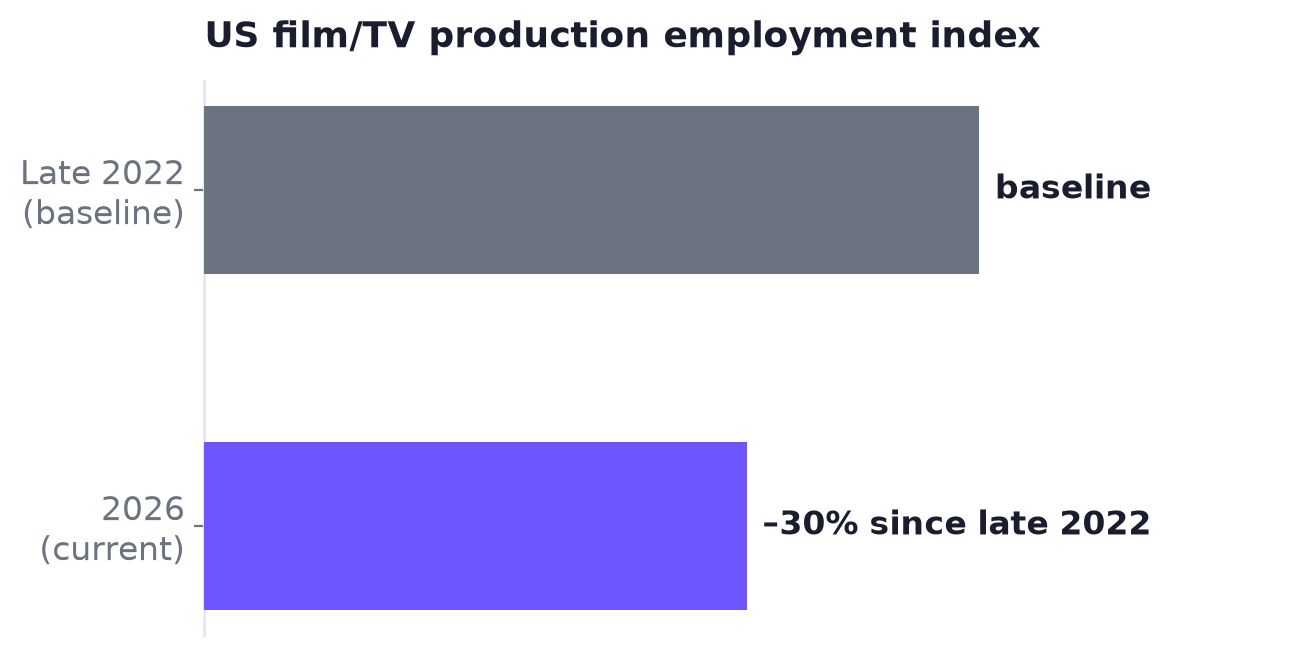
Media and entertainment companies announced more than 17,000 job cuts in 2025, an 18% increase over 2024.1 U.S. film and TV production employment has fallen roughly 30% since late 2022, and on-location production in Los Angeles — historically the industry's home base — declined 22% year-over-year in Q1 2025 and a further 13.2% in Q3 2025.3 Advertising and PR employment fell 9.9% year-over-year as of May 2025, a loss of roughly 54,000 positions.1
Yet it isn't uniform decline: BLS projects advertising and related services employment to grow 8% from 2023–2033.1 The picture is restructuring, not simple contraction — headcount is being redistributed toward project-based and specialized roles.
02 — The Production ShiftWhy has production employment fallen so far?
Studios are moving to project-by-project staffing with skeleton full-time teams.
Disney/Marvel's 2026 restructuring illustrates the new operating model: a project-by-project staffing approach where most departments are let go between productions except a small full-time core.2 FilmLA called 2024 the "second least productive year" on record for Los Angeles production, and the decline has continued into 2025.7
This shift changes what "hiring" means in the industry: instead of one big staffing wave per show, employers now run many smaller, faster staffing sprints — and need a reusable bench of vetted freelance talent rather than a one-time recruiting push.
03 — The ClockHow long does it take to staff a production?
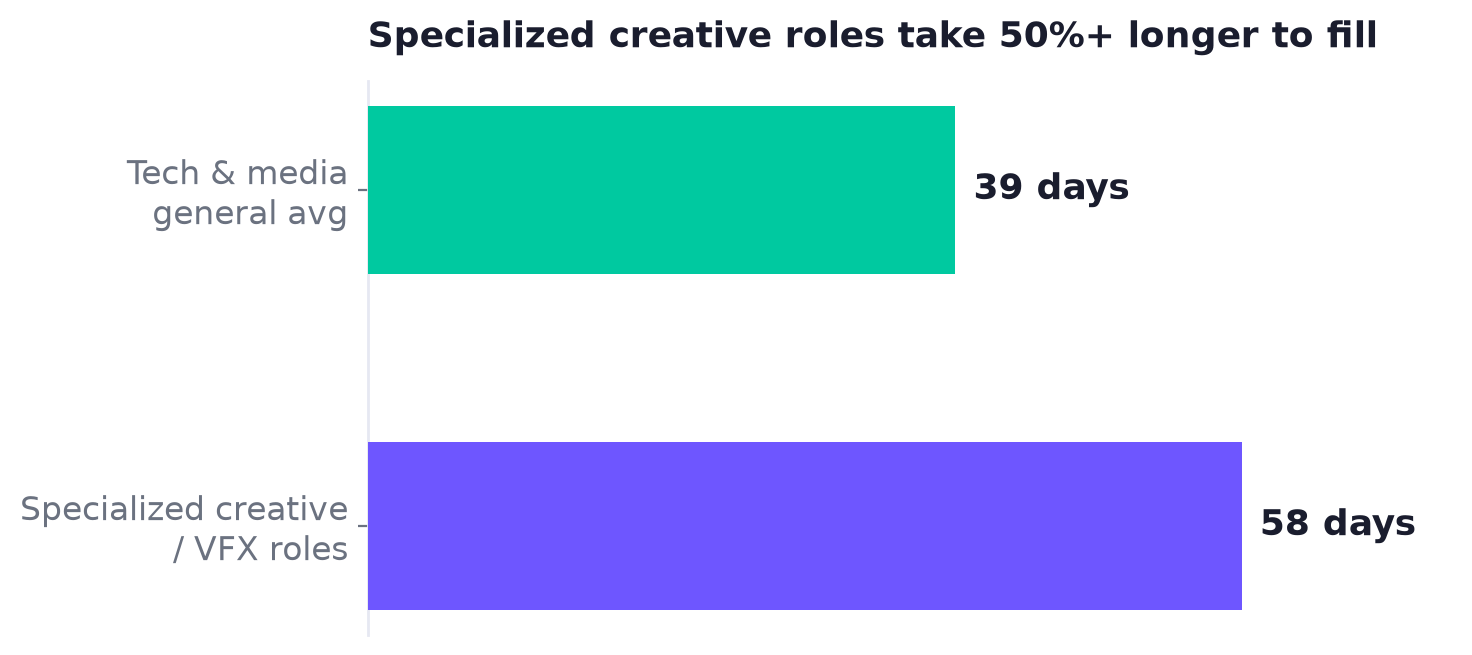
Specialized creative and VFX roles take 50%+ longer to fill than general tech and media roles.
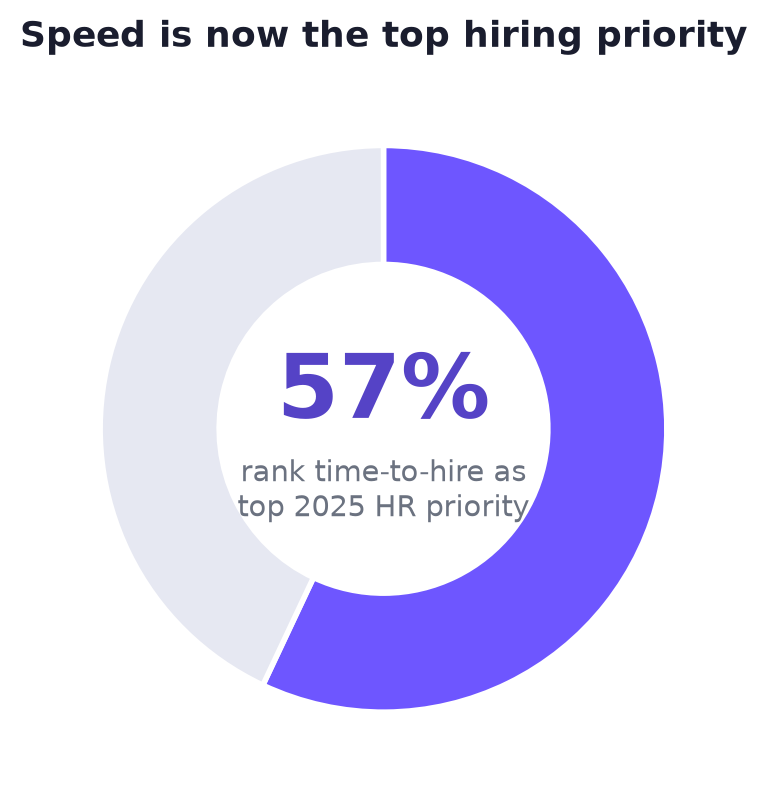
General "Tech & Media" time-to-fill benchmarks run around 39 days, but specialized, technical, or senior creative and VFX roles run 45–70+ days given credentialing, portfolio review, and multi-stakeholder creative approval.6 Industry-wide, all-industry average time-to-hire stretched from 36–44 days in 2023 to 63–68 days by January 2026 — and 57% of tech, media, and entertainment HR leaders now rank reducing time-to-hire as their #1 2025 priority, ahead of automation, safety, and retention.65
"A greenlit production doesn't wait for a 60-day search. If your bench isn't already vetted, you've already lost the schedule."
04 — The Skills ShiftWhat talent actually gets scarcer as AI adoption rises?
As execution work automates, the scarce skill shifts to creative judgment and AI-output evaluation.
McKinsey finds studios expect 80–90% efficiency gains in VFX and 3D asset creation from generative AI — but the technology augments, rather than replaces, creative judgment in the near term.4 Deloitte projects gen-AI content-creation spend will stay under 3% of production budgets near-term, even as roughly 7% of operational spend shifts toward gen-AI-enabled contract and talent-management tools.8 PwC separately finds wages rising faster in AI-exposed sectors, with revenue growth nearly quadrupling since 2022 in those segments.1
The net effect: the people who can direct AI tools, catch brand and factual errors, and make final creative calls become more valuable even as routine execution work compresses — a bifurcation similar to what's playing out in technical hiring more broadly.
05 — The PlaybookWhat should a media or entertainment talent team do about it?
Five moves separate the studios and production companies that will staff productions on deadline:
1. Build a reusable, verified freelance bench. Continuously refreshed pools of pre-qualified editors and VFX artists let a crew assemble in days, not weeks.
2. Compress time-to-fill for specialized roles. Automated sourcing and screening cut days out of a hiring window that averages 45-70+ for creative specialists.
3. Screen for hybrid creative-technical judgment. Target candidates who can direct and evaluate AI-generated output, not just operate software.
4. Track production geography in real time. Re-target regional talent pools as incentive-driven production shifts occur.
5. Treat every production as a staffing sprint. Design sourcing workflows for repeatable, fast crew assembly rather than one-time recruiting campaigns.
This is precisely the model UPPER was built to run: autonomous, compliant sourcing that keeps a verified freelance bench warm and ready, so productions greenlit with only weeks of lead time can staff a full crew before the shoot window closes.
Get the designed PDF edition
The full report, formatted as a shareable PDF for your team and clients. Enter your work email and we'll unlock the download.
★ Download the PDFSources
- Mediabistro (citing Challenger, Gray & Christmas / BLS) — Media Industry Jobs Are Being Rewritten
- Forbes — Studios Are Cutting Staff, Freelancers Will Pay the AI Bill, July 2026
- FilmLA — Research & Updates on Los Angeles Production
- McKinsey — How AI Could Reinvent Film and TV Production, November 2025
- Pivotal Customer — Future-Ready Hiring Trends, November 2025
- The Resource Company — Time to Fill by Industry, October 2025
- WSWS (citing FilmLA) — Los Angeles Production Decline Data
- Deloitte — TMT Predictions: Hollywood Cautious of GenAI Adoption, 2025
- U.S. Bureau of Labor Statistics — Motion Picture and Sound Recording Industries (NAICS 512)
- Corporate Navigators — Average Time to Fill by Industry, 2024
This report synthesizes third-party research current as of July 2026; figures are attributed to their original sources above. Some forward projections are inherently uncertain. UPPER edition H2 2026 — refreshed semiannually.